Best group exercises at home or in the office: 40 team workouts
40 moves and drills for a team in one room or on one video call, each with a low-impact version. Plus three timed circuits and a free timer to run them.
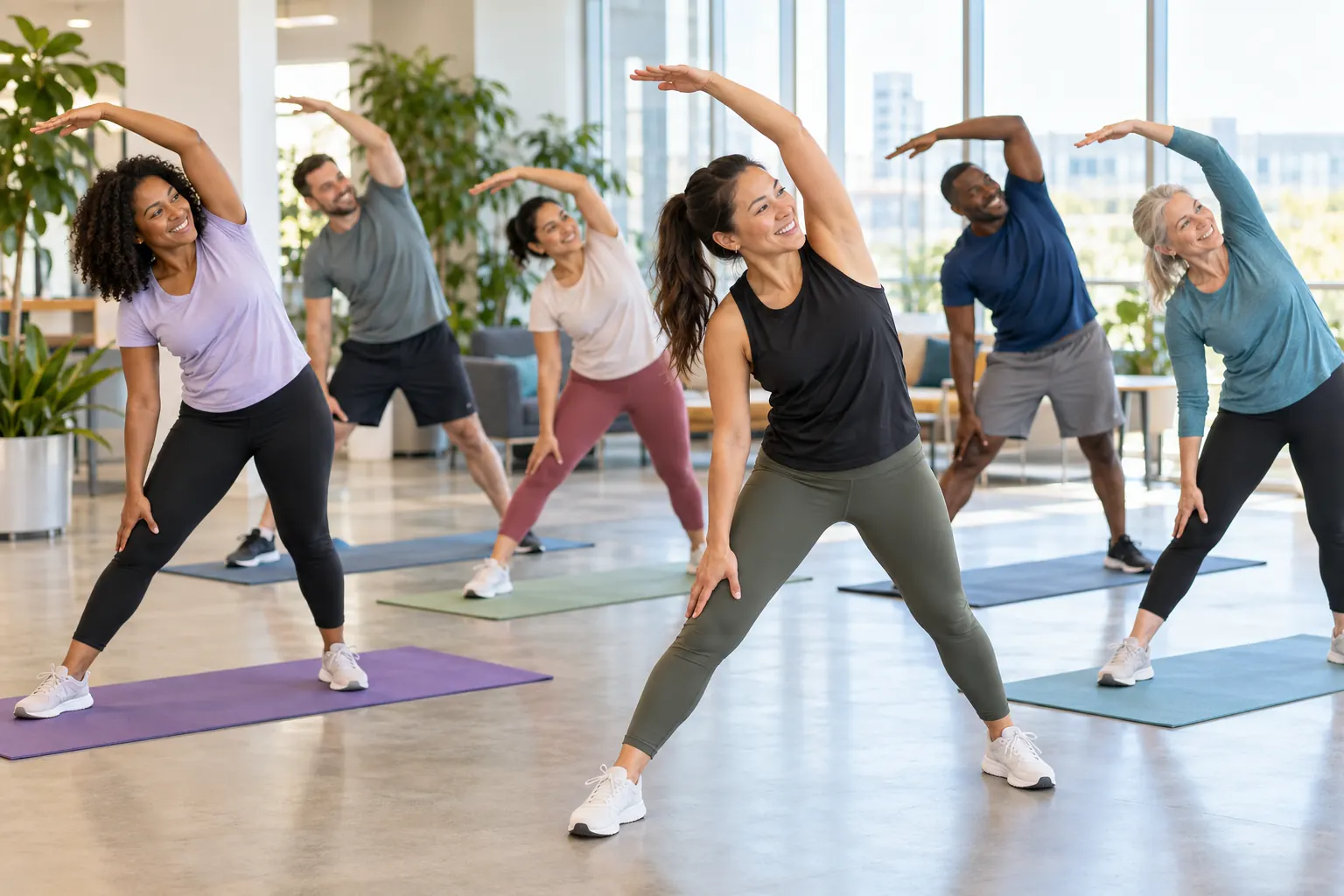
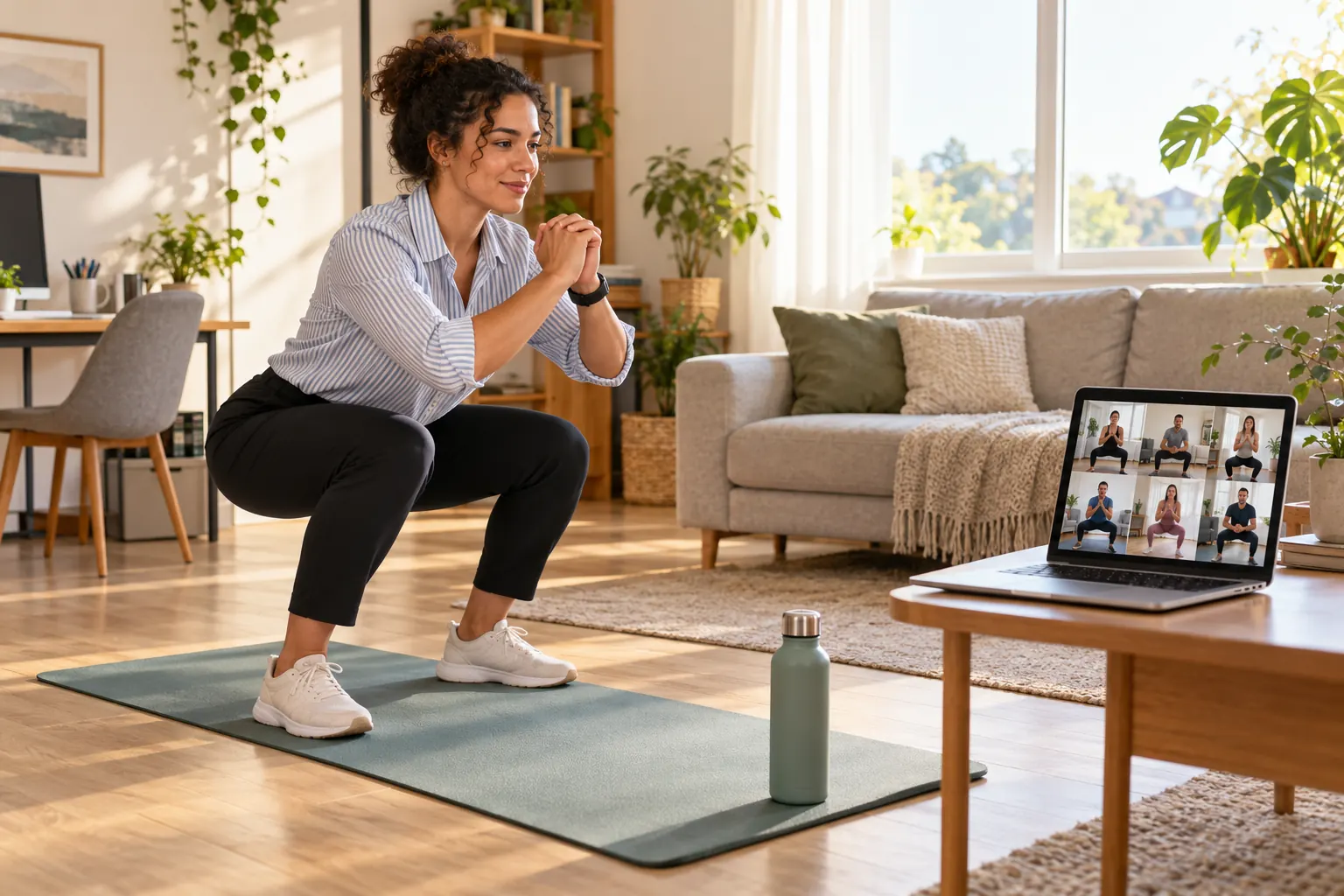
The best group exercises at home are the ones nobody has to buy anything for: squats, lunges, planks and marching, done together on a call or in the living room. The same moves work in an office meeting room. This page has 40 group exercises for adults, grouped by where and how you’ll do them, three ready-made circuits of 10, 20 and 30 minutes, and a timer that runs a circuit for the whole group.
The 40 best group exercises at home or at work
These exercises for group fitness are numbered down the page so a leader can call them out. Each has an easier line: the low-impact version, and it counts the same.
No-equipment group exercises for a living room or office
The building blocks of every circuit below. Each needs about a yoga mat's worth of floor and nothing else.
- Bodyweight squat. Feet hip-width apart, sit back as if into a chair, then stand tall. Easier: Sit all the way down onto a real chair and stand back up.
- Push-up. Hands under shoulders, body in one line, lower your chest and press back up. Easier: Hands on a wall or a sturdy desk edge instead of the floor.
- Reverse lunge. Step one foot back, bend both knees, then push through the front heel to stand. Easier: Take a shorter step and hold a chair back for balance.
- Side lunge. Step wide to one side, sit into that hip with the other leg straight, push back. Easier: Bend only a little and keep a hand on a wall.
- Glute bridge. Lie on your back, knees bent, and lift your hips until your body is a straight ramp. Easier: Lift halfway and lower slowly.
- Forearm plank. Forearms on the floor, body straight from head to heels, breathe and hold. Easier: Knees on the floor, or hands on a desk with feet stepped back.
- Jumping jacks. Jump feet wide as arms go overhead, then jump back together. Easier: Step one foot out at a time while the arms rise.
- High knees. Run in place, driving each knee up toward hip height. Easier: March in place, lifting knees as high as is comfortable.
- Mountain climbers. From a high plank, drive one knee toward your chest, then switch quickly. Easier: Hands on a chair seat or desk, stepping the knees in slowly.
- Skaters. Hop side to side, landing on one foot with the other sweeping behind. Easier: Step side to side and tap the back toe down, no hop.
- Bird dog. On hands and knees, reach one arm forward and the opposite leg back, then switch. Easier: Move only the leg, or only the arm.
- Dead bug. On your back, arms up and knees bent over hips, lower the opposite arm and leg, then switch. Easier: Keep the arms still and tap one heel to the floor at a time.
- Chair dip. Hands on the edge of a sturdy chair without wheels, bend the elbows to lower, press up. Easier: Bend your knees, keep feet close and lower only a little.
- Wall sit. Back against a wall, slide down until your knees are bent, and hold. Easier: Stay higher on the wall and hold for half the time.
Partner and team drills
Group fitness drills where people work together, in a room or on a video call. They double as small group exercises for team building.
- Mirror moves. Partners face each other; one leads slow moves for 30 seconds, the other copies, then swap. Easier: Leaders stick to seated or arm-only moves.
- Plank high fives. Partners hold a high plank face to face and take turns tapping hands. Easier: Both stand at arm's length and tap hands while marching in place.
- Back-to-back squat. Partners stand back to back and lower into a squat together, leaning on each other. Easier: Go only halfway down, or both squat to chairs side by side.
- Sock toss squats. Partners toss a rolled pair of socks back and forth, with a squat after every catch. Easier: Swap the squat for a sit-to-stand from a chair.
- Towel tug row. Partners hold opposite ends of a towel; one pulls slowly while the other gently resists. Easier: Use lighter resistance and keep both feet planted.
- Follow-the-leader circle. In a circle or a video grid, each person calls a move for 30 seconds and everyone follows. Easier: Each leader calls the move and its low-impact version together.
- Number call. Give four moves a number each; the leader shouts numbers at random and the group switches. Easier: Make one number a march in place, and anyone can choose it anytime.
- Rep relay. Each person in turn does ten reps of a move while the group counts out loud, then names the next person. Easier: Each person picks their own move from the low-impact list.
- Deck of cards drill. Each suit is a move and the card's number is the reps, face cards ten; flip one and the group does it together. Easier: Halve every number and swap jumps for steps.
- Tabata team round. Eight rounds of 20 seconds of one move and 10 seconds of rest, four minutes, everyone together. Easier: Pick a march, step-jack or wall push-up for the move.
Desk-break moves
Two to five minutes, work clothes on, no sweat. Good between meetings.
- Desk calf raises. Hold the desk, rise onto your toes, and lower slowly for 15 reps. Easier: Seated: lift the heels, then the toes, in turn.
- Seated march. Sit tall at the front of the chair and lift one knee after the other for a minute. Easier: Lift the feet only an inch off the floor.
- Wall angels. Back and arms against a wall, slide the arms up and down like a slow snow angel. Easier: Stand a step away from the wall and keep the range small.
- Doorway chest stretch. Forearms on either side of a doorway, step through gently until you feel the chest open. Easier: Use one arm at a time and lean only slightly.
- Standing hip flexor stretch. Hold the desk, step one foot back, tuck the hips and hold for 30 seconds a side. Easier: Take a shorter step and keep the back heel down.
- Seated spinal twist. Sit tall, turn your chest to one side with a hand on the chair back, breathe, switch. Easier: Turn only as far as is comfortable, no pulling.
- Wrist and forearm stretch. Arm straight, palm out, gently draw the fingers back with the other hand; then palm down. Easier: Bend the elbow slightly and press more lightly.
- Desk hamstring hinge. Hands on the desk, step back and hinge at the hips with a flat back until the legs stretch. Easier: Keep a soft bend in the knees and hinge less.
Team fitness challenges
Run over days or weeks. Score teams, never bodies, and count every version of a move the same.
- Plank relay. Keep one plank going at all times as a team; each person holds as long as they like, then hands off. Easier: A knee plank or a desk plank counts the same.
- Lunch hour step sprint. Teams add up the steps they take during one lunch hour and post the total by 2 p.m. Easier: Wheelchair pushes and minutes of any movement count too.
- Squat ladder month. Five squats on day one, one more each workday; teams log who kept the streak. Easier: Chair sit-to-stands count, and any day can repeat yesterday's number.
- 100-rep team total. On a call, the team works together to reach 100 push-ups in five minutes, any version. Easier: Wall push-ups count as one rep each, like any other.
- Team wall-sit average. Everyone times one wall sit; teams compare their average, and next week tries to beat it. Easier: A higher wall sit counts, and so does a short one.
- Movement bingo card. A card of small tasks, like ten squats or a two-minute walk; the first team to fill a line wins. Easier: Give every square a seated option on the card.
- Same-time daily circuit. For two weeks, the team does the 10-minute circuit below at the same time each day and tallies turnout. Easier: Joining for half the circuit counts as joining.
- Move every hour pledge. For one week, stand and move for two minutes every hour of the workday; teams count hours logged. Easier: Any two minutes of movement count, seated or standing.
For a full step challenge with scoring rules, see our workplace wellness challenges. If the team would rather play than train, our outdoor games for adults and office desk games get people moving without calling it a workout.
3 group workout circuits, with a free timer
Pick a length and press Start. The timer walks the group through the warm-up, every move and rest, and the cool-down, and beeps at each change. Share your screen to use it for virtual group workouts.
Start easy
Warm-up
1:00
March in place, roll the shoulders and swing the arms.
Next: Bodyweight squat
Press Start when everyone is ready.
The 10-minute circuit
A meeting opener or a daily habit. Fine in work clothes on the low-impact versions. 2 rounds of 4 moves: 40 seconds on, 20 seconds rest.
- 1 min Warm-up: March in place, roll the shoulders and swing the arms.
- 0:40Bodyweight squat
- 0:40Jumping jacks
- 0:40Push-up
- 0:40Reverse lunge
- 1 min Cool-down: Walk it off slowly, then stretch the legs, hips and shoulders.
The 20-minute circuit
A lunchtime class on a video call, with time to change back after. 3 rounds of 5 moves: 40 seconds on, 20 seconds rest.
- 2 min Warm-up: March in place, roll the shoulders and swing the arms.
- 0:40Side lunge
- 0:40High knees
- 0:40Glute bridge
- 0:40Mountain climbers
- 0:40Dead bug
- 3 min Cool-down: Walk it off slowly, then stretch the legs, hips and shoulders.
The 30-minute circuit
A full group workout for a wellness week or a team that already moves together. 3 rounds of 8 moves: 45 seconds on, 15 seconds rest.
- 3 min Warm-up: March in place, roll the shoulders and swing the arms.
- 0:45Bodyweight squat
- 0:45Skaters
- 0:45Push-up
- 0:45Bird dog
- 0:45Reverse lunge
- 0:45Forearm plank
- 0:45Chair dip
- 0:45Wall sit
- 3 min Cool-down: Walk it off slowly, then stretch the legs, hips and shoulders.
Repeat the move list for each round, with the rest after every move. Planning a whole day outdoors instead? Our company picnic ideas cover games for every fitness level.
Office fitness equipment that earns its space
You don't need a gym. This low-cost office workout equipment covers most sessions and stores in a cupboard.
- Exercise mats. A stack of thin mats makes office carpet usable for planks and bridges. Wipe them after each use.
- Resistance bands. Light to medium loops and long bands cover rows, presses and leg work, and fit in a drawer.
- A few light dumbbells. Two or three pairs at different weights are plenty. Store them on a low rack, not under desks.
- A foam roller. Popular after desk days. One or two shared rollers in a quiet corner get used.
- A stability ball. Good for core work and stretching. As a full-day chair it's mixed, so treat it as a tool, not furniture.
- A sturdy step. A low aerobic step or a solid step stool adds step-ups to any circuit.
- A screen for the timer. A TV or laptop on a cart so the whole room can see the current move and the clock.
Skip anything that needs a trainer to use safely, and anything people would have to change clothes for at their desk. Ask the team what they would actually use before you order.
How to start a corporate fitness program in 5 steps
Corporate fitness works when it feels like an invitation, not a policy. Five steps, in order.
- Make it opt-in. Invite, don't assign. No attendance tracking by managers, and no cost for saying no.
- Make it inclusive. Offer a low-impact or seated version of everything, run some sessions on video for remote staff, and ask what people actually want before you buy anything.
- Put it on the calendar. Same day, same time, inside the workday, such as a 20-minute class on Tuesdays at noon. A recurring invite beats an occasional email.
- Measure participation, not bodies. Count who joins and how often, and ask how people feel in a short survey. Never track weight, body measurements or calories.
- Refresh it every quarter. Rotate formats, from circuits to a hosted class or a team challenge, and drop what nobody comes to.
Fitness is one part of a wider plan. Our guide to building an employee wellness program covers the rest, and stress management activities help in busy seasons when nobody has time to train.
Book a live fitness class for the team
Want someone else to lead? Each of these is a 60-minute class with a live instructor on your team's video call, on Zoom by default, or Teams, Google Meet or Webex on request. People join from home or together from the office. Book about 2 weeks ahead, or get a free quote.
- Hiit Happens: fast intervals of cardio and strength, with modifications for every level. For teams that like a hard workout.
- Barre it All: a high-intensity barre workout for strength, stability and endurance. For people who like control more than jumping.
- Beatz: a dance fitness class to hip-hop, funk and pop, with no dance background needed. For the most fun per minute.
- Flex Appeal: an upper-body class of resistance, bodyweight and functional moves for arms, core and posture. For desk-bound shoulders.
- Yoga: Yin yoga with deep stretches held for longer, for flexibility and relaxation. Each person needs a yoga mat.
All five classes, with today's price.
See every workplace wellness class, or plan a year of them with an annual wellness program.