How to make a succulent terrarium that lasts
Open glass, fast soil, the right plants and very little water. Every care tip comes from an extension service or the RHS.

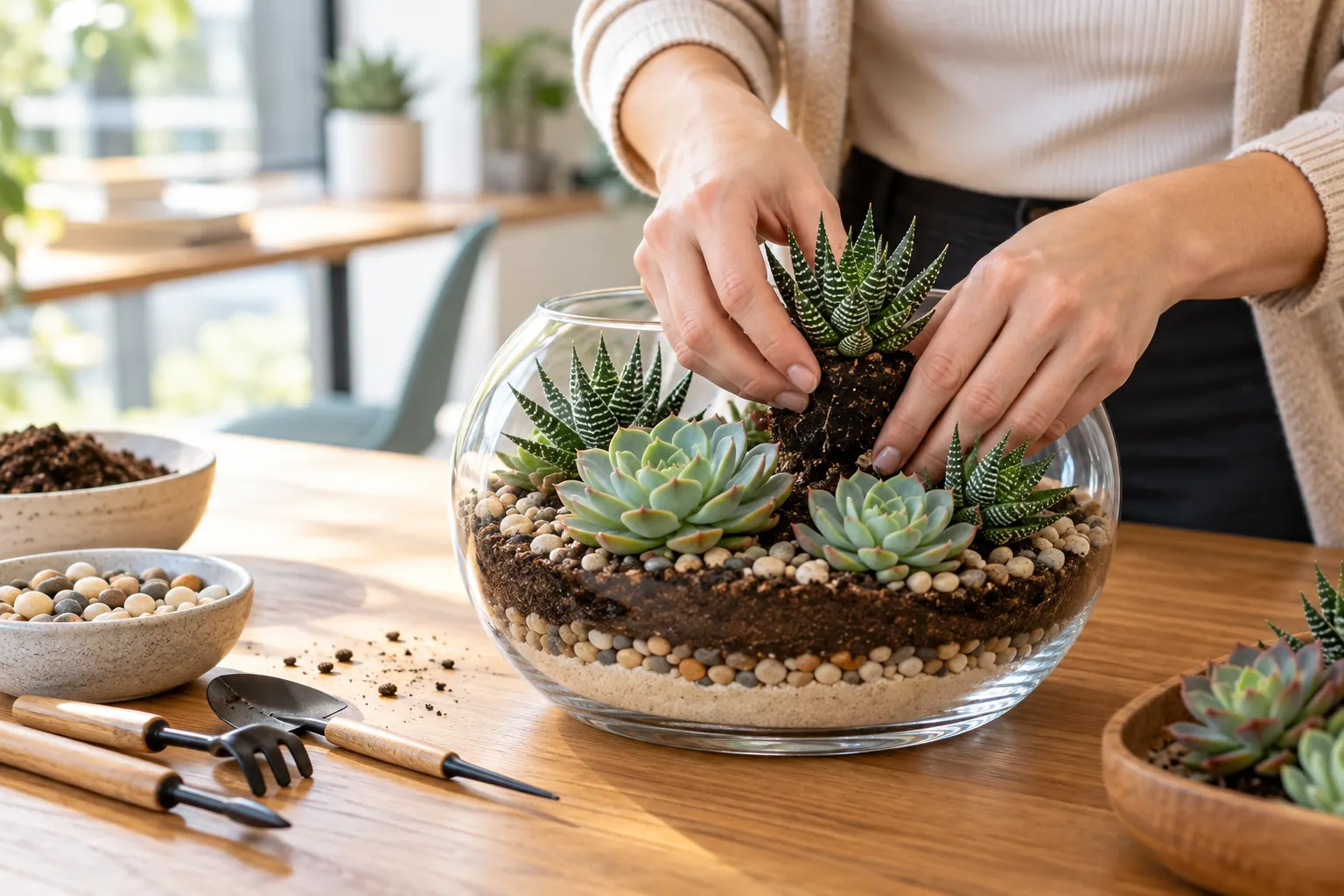
A succulent terrarium is a small garden of succulents in an open glass container. It takes about half an hour to build. Keeping it alive comes down to three things most tutorials skip: an open container, soil that drains fast, and watering by the spoonful, because glass has no drainage hole. Below: the supplies, 8 steps, 11 plants that fit (with pet safety for each), a care routine and fixes for the problems you are most likely to see.
Open or closed: succulents need an open terrarium
Succulents come from dry places. A lid or narrow neck traps humidity and they rot, so pick a container with a wide opening.
| Type | Container | Plants it suits |
|---|---|---|
| Open | A bowl, an open cube, a wide vase | Succulents and cacti |
| Closed | A lidded jar, a bottle, a cloche | Ferns, mosses, nerve plants |
Succulent terrarium supplies
Everything fits on one shopping list.
- A clear glass container with a wide opening, at least 4 inches deep (tinted glass blocks light).
- Small succulents in 2-inch or 3-inch nursery pots, with room to space them out.
- Small gravel or pebbles for the bottom layer.
- Horticultural charcoal (optional).
- Coarse sand for a thin barrier layer.
- Cactus and succulent potting mix.
- Top dressing: colored sand, small stones or crushed glass.
- A spoon, chopsticks or long tweezers, and a soft paintbrush.
- A squeeze bottle or small watering can with a narrow spout.
- Gloves if you add a cactus.
How to make a succulent terrarium in 8 steps
Cover the table first. Bottom to top, the layers are gravel, charcoal, sand, soil, plants and top dressing.
Pick an open container. Clear glass with a wide mouth. A lidded or narrow-neck jar holds humidity, and succulents rot in it.
Source: Mississippi State ExtensionPrep the day before. Water the plants in their nursery pots, wash the glass, and rinse any stones you plan to add.
Sources: Mississippi State Extension, RHSAdd 1/2 to 1 inch of gravel. It catches extra water below the roots. It is not drainage: the water has nowhere to go, so treat it as a safety margin.
Sources: UC ANR 4-H, Iowa State ExtensionSprinkle a thin layer of charcoal (optional). Extension sheets use it; the RHS terrarium guide skips it. Pour it through a paper funnel to keep the glass clean.
Sources: Mississippi State Extension, UC ANR 4-HAdd a thin layer of sand, then about 2 inches of cactus mix. Cactus mix is fast-draining and holds little water, which is what succulents in a pot with no hole need.
Sources: UC ANR 4-H, Mississippi State ExtensionPlant, tallest in the center. Tip each plant out, gently break up the root ball, and set the tallest toward the center. Leave space between plants and keep every leaf off the glass.
Source: Mississippi State ExtensionTop dress and clean up. Spoon sand or small stones around the plants, then brush or mist soil off the leaves and the glass.
Source: RHSWater lightly and find the light. Moisten the soil at the base of each plant and stop before water shows in the gravel. Then move it to its bright spot.
Source: UC ANR 4-H
11 best succulents for a terrarium
Small or slow growers that suit an open bowl. 4 are non-toxic to cats and dogs, per the ASPCA. Buy plants in 2-inch or 3-inch pots and group ones with similar light needs.
1. HaworthiaHaworthia species
The best desk pick: 2 to 12 inches tall, low-maintenance, and NC State suggests it for terrariums.
Light: Bright indirect light; somewhat tolerant of lower light.
Pets: Non-toxic to cats and dogs (ASPCA).
Sources: NC State, ASPCA (cats), ASPCA (dogs)2. Gasteria (ox tongue)Gasteria
Small and slow, usually about 6 inches tall in a pot.
Light: Bright light; unlike many succulents it tolerates some shade.
Pets: Not on the ASPCA lists: keep away from pets to be safe.
Source: NC State3. EcheveriaEcheveria species
The classic rosette, mostly 1 to 12 inches, in gray, blue and green.
Light: The sunniest spot you have; leaf color improves with sun.
Pets: Non-toxic to cats and dogs (ASPCA).
Sources: NC State, ASPCA (cats), ASPCA (dogs)4. Hens and chicksSempervivum
Low rosettes that make offsets; NC State names terrariums and dish gardens as good uses.
Light: Full sun with some afternoon shade; less heat-tolerant than other succulents.
Pets: Not on the ASPCA lists: keep away from pets to be safe. (The ASPCA's "hens and chickens" is an echeveria.) NC State notes the sap can irritate skin.
Source: NC State5. Ghost plantGraptopetalum paraguayense
Pale rosettes 3 to 6 inches across; stems trail over stones and can be pruned.
Light: Full sun to partial shade; leaves turn bluish with less sun.
Pets: Non-toxic to cats and dogs (ASPCA).
Sources: NC State, ASPCA (cats), ASPCA (dogs)6. Burro's tailSedum morganianum
Trailing stems for a tall or hanging bowl; leaves break off if handled.
Light: High light, such as a windowsill with some sun.
Pets: Non-toxic to cats and dogs (ASPCA).
Sources: NC State, ASPCA (cats), ASPCA (dogs)7. Jade plant (a compact cultivar)Crassula ovata
A tiny tree shape; pick a compact cultivar, since the species can reach 3 feet or more.
Light: A sunny spot with some afternoon shade.
Pets: Toxic to cats and dogs (ASPCA).
Sources: NC State, ASPCA (cats), ASPCA (dogs)8. Panda plantKalanchoe tomentosa
Fuzzy gray leaves with chocolate-brown spots on the edges; slow-growing.
Light: Bright indirect light for at least 6 hours a day.
Pets: Toxic to cats and dogs (ASPCA). The ASPCA lists Kalanchoe species as toxic.
Sources: NC State, ASPCA (cats), ASPCA (dogs)9. Flaming KatyKalanchoe blossfeldiana
The flowering one: compact, 6 to 18 inches, with long-lasting blooms.
Light: Bright indirect light; long direct sun scorches the leaves.
Pets: Toxic to cats and dogs (ASPCA).
Sources: NC State, ASPCA (cats), ASPCA (dogs)10. Aloe vera (a young plant)Aloe vera
Spiky rosettes for height; start with a small pup and move it on once it outgrows the glass.
Light: Full sun to partial shade.
Pets: Toxic to cats and dogs (ASPCA).
Sources: NC State, ASPCA (cats), ASPCA (dogs)11. Aeonium (a compact species)Aeonium
Glossy rosettes in green or dark purple; Aeonium tabulaeforme and smithii stay compact.
Light: A well-lit place; too much sun can scorch the leaves.
Pets: Not on the ASPCA lists: keep away from pets to be safe.
Source: NC State
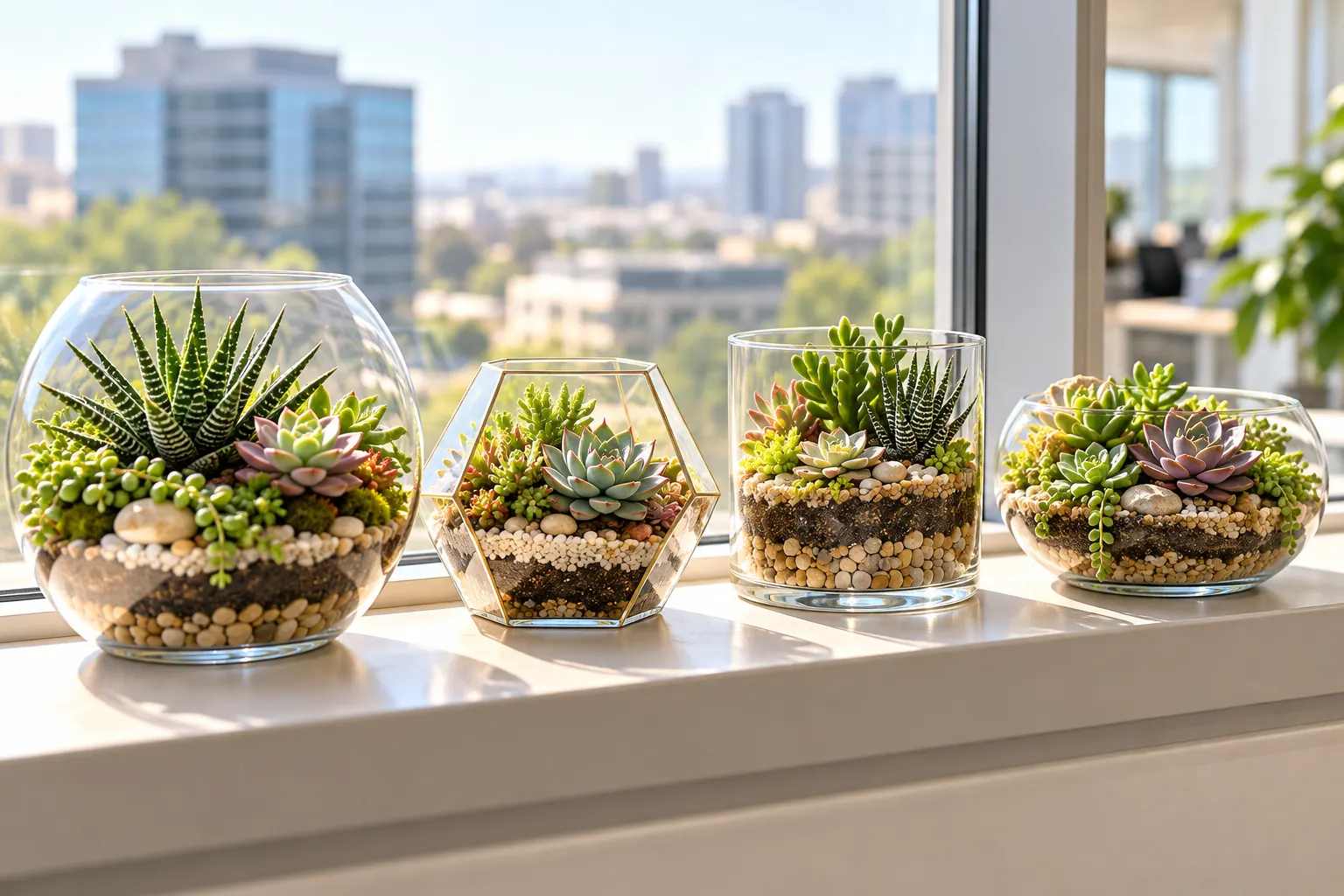
Skip ferns, mosses and other humidity lovers in the same bowl: they want the opposite care. More plant trivia for your team channel is on our plant facts page.
Succulent terrarium care
Bright light, rare water, and a look every week or two.
- Light: at least 6 hours of bright light a day. Keep hot direct sun off the glass, which builds heat inside and can burn plants; an east window is often ideal. Sources: RHS, Iowa State Extension, Mississippi State Extension
- Water: start at every 2 to 3 weeks, and only once the soil is dry; if it is still damp, wait a few days. Aim a narrow spout at the soil and never fill the gravel. Sources: UC ANR 4-H, Iowa State Extension
- Turn it: give the bowl a quarter turn now and then so the plants grow evenly instead of leaning toward the window. Source: Iowa State Extension
- Feed rarely: slow growth keeps a terrarium tidy. At most, use an all-purpose fertilizer at a quarter to half the label rate in spring and summer, and none in winter. Source: Iowa State Extension
- Tidy up: pull dead leaves out promptly, before they rot, and trim any stem that reaches the glass. Source: RHS
- Refresh it: a terrarium usually looks its best for a year or two. Then move the biggest plants into pots with drainage and replant. Source: Mississippi State Extension
Troubleshooting: 9 common problems
Most terrarium problems trace back to water or light.
- Stretched, pale stems leaning to one side
- Too little light. Move it brighter or add a grow light. For a leggy plant, cut off the top with an inch of stem and replant it.
- Sources: Iowa State Extension, NC State
- Yellow, soft or see-through leaves
- Too much water. Stop watering until the soil is dry. Pull out any plant that has gone mushy at the base.
- Sources: Iowa State Extension, NC State
- Wrinkled, deflated lower leaves
- Too dry. Water a little more at the next watering, still without filling the gravel.
- Sources: Iowa State Extension, NC State
- Water standing in the gravel
- One watering too many. Wick it out with a rolled paper towel and skip the next watering.
- Source: UC ANR 4-H
- Fog on the glass or fuzzy mold
- Too much moisture and too little air. Wipe the glass, remove the moldy bits, and keep the container open in moving air.
- Source: RHS
- Brown or bleached patches on sunny-side leaves
- Hot sun through the glass. Move it out of direct midday sun; bright light without the heat.
- Sources: Mississippi State Extension, NC State
- Rot where a leaf touches the glass
- Moisture trapped between leaf and glass. Trim the leaf or shift the plant so nothing rests on the glass.
- Source: Mississippi State Extension
- White, cottony specks in leaf joints
- Mealybugs, a common succulent pest. Pull out a badly infested plant, keep air moving around the rest, and check nearby plants.
- Source: Iowa State Extension
- A plant now fills the bowl
- Normal growth. Move it to its own pot with a drainage hole and plant a smaller one in its place.
- Source: Mississippi State Extension
Make terrariums with your team
In the office: buy one container and two or three plants per person, set out shared tubs of gravel, sand, cactus mix and top dressing, and cover the tables. Forty-five minutes is enough, and everyone leaves with a desk plant. Our gardening team building ideas have more ways to grow things together.
For a remote or hybrid team: in our hosted Terrarium Making workshop, a live-plant kit ships to each guest and a host walks everyone through the build and long-term care in one hour on video. Prefer nothing to water? Zen Garden is sand, stones and a tiny rake, shipped within the continental US. For a team that cooks, see our virtual herb garden class.
Book at least 16 days ahead (3 to 4 weeks for international addresses), and earlier if you want a December date. Prices, kit details and shipping reach are on our virtual terrarium workshop page.
Hosted kit workshops, with today’s price.
Send your date and headcount and get a free quote. We reply within 24 hours.