100 plant facts, every one checked against a source
Fun facts about plants from Kew, the USDA, national parks, universities and journals, with the link next to each one. Plus a 15-question plant trivia round.

Most plant facts online repeat each other, and a fair share are myths. These 100 plant facts each come with the page that backs them, so you can share one in the team channel without a fact check reply. They are grouped by theme, and a 15-question plant trivia round with new facts follows the list.
Plant record-setters
The tallest, oldest, smallest and fastest, each linked to the record keeper or study behind it.
Hyperion, a coast redwood in California's Redwood National Park, is the tallest known living tree, at about 116 m (380 ft).Guinness World Records
A seagrass meadow in Shark Bay, Western Australia, turned out to be one ribbon weed clone stretching at least 180 km across the bay.PubMed Central
Pando, in Utah's Fishlake National Forest, is one quaking aspen clone of about 47,000 genetically identical stems covering about 43 hectares (106 acres).PLOS ONE
Old Tjikko, a Norway spruce in Sweden, has a root system dated to about 9,500 years old, though the trunk you see is much younger.ScienceDaily
A Judean date palm seed about 2,000 years old, found at Masada, sprouted in 2005; the tree is nicknamed Methuselah.PubMed Central
In a study published in 2012, Russian scientists grew flowering plants from fruit tissue of narrow-leaf campion frozen about 32,000 years in Siberian permafrost.PubMed Central
A sacred lotus seed about 1,300 years old, found in a dry lakebed in northeastern China, was germinated by scientists.Journal article
The Jaya Sri Maha Bodhi fig in Sri Lanka, planted in 288 BC, is the oldest living tree planted by people with a known planting date.Guinness World Records
Welwitschia, a Namib Desert plant of Namibia and southern Angola, grows only two leaves in its whole life, and some plants are thought to be over 1,000 years old.SANBI
Some bamboo species can grow about 91 cm (35 in) in a single day, the fastest growth of any plant.Guinness World Records
The bunchberry dogwood flings its pollen out as its flower opens in less than half a millisecond, one of the fastest movements recorded in a plant.Nature
The smallest flowering plants are watermeal (Wolffia), rootless floating duckweeds under 2 mm long.Loyola University
The titan arum, or corpse flower, has the largest unbranched flower cluster in the world, and it smells of rotting flesh to draw in pollinating insects.US Botanic Garden
The talipot palm grows the largest branched flower cluster of any plant. It flowers only once, after decades, and then dies.NParks Singapore
In 2022, scientists at Kew named a new species of giant waterlily, Victoria boliviana, whose leaves can grow to about 3 m across.Frontiers in Plant Science
Houseplant and office plant facts
The plants on your desk, plus the pet-safety facts worth knowing before you buy one.
Air plants (Tillandsia) soak up water and nutrients through tiny scales on their leaves called trichomes; their roots mostly just hold on.Clemson Extension
Golden pothos almost never flowers; a 2016 study with University of Florida scientists found it makes too little gibberellin, a hormone that triggers its flowering.PubMed Central
Snake plants use CAM photosynthesis: they open their leaf pores at night to take in carbon dioxide, which saves water during the day.PubMed Central
A ZZ plant grows from thick, fleshy underground rhizomes and stores water in them and its leaves, so it can go weeks without watering.NC State Extension
The holes in a monstera leaf are called fenestrations.University of South Florida
Monstera deliciosa grows an edible fruit, but only when fully ripe; unripe fruit contains oxalates that irritate the mouth.Purdue University
A peace lily is not a true lily: it belongs to the arum family, Araceae, along with monstera and philodendron.NC State Extension
True lilies (Lilium) and daylilies can cause kidney failure in cats, even from licking pollen or drinking vase water.FDA
Many popular houseplants, including pothos, philodendron and dieffenbachia, contain calcium oxalate crystals that irritate the mouths of pets that chew them.ASPCA
The Chinese money plant reached Norway with a missionary who brought it from China in 1946, and it spread from there through cuttings.Store norske leksikon
The Christmas cactus comes from rainforest cacti of the coastal mountains of southeastern Brazil, which grow on trees and rocks, not in desert sand.NC State Extension
The fiddle-leaf fig is native to tropical western and central Africa, where it grows into a tree 60 to 100 feet tall.Missouri Botanical Garden
Almost every cactus is native to the Americas; the one likely exception is the mistletoe cactus, which also grows wild in tropical Africa, Madagascar and Sri Lanka.Britannica
Almost all cacti are succulents, but most succulents are not cacti. Cacti are identified by areoles, the cushion-like spots their spines grow from.Britannica
Bromeliads such as the urn plant hold a pool of water in a cup of leaves, and in the wild hundreds of insect species and other small animals live in these pools.PubMed Central
A jade plant can grow a whole new plant from a single leaf, even a stray one that falls off and roots in the soil.NC State Extension
The prayer plant holds its leaves flat by day and raises them upright at night, like hands folded in prayer, which is how it got its name.NC State Extension
The cast-iron plant is named for its ability to survive neglect, and it copes with shade too deep for most houseplants.Missouri Botanical Garden
Ferns such as the Boston fern make spores, not seeds; the brown dots under the fronds are clusters of spore cases called sori.NC State Extension
Overwatering is the main cause of death for potted plants: roots sitting in soggy soil cannot take up oxygen, so they rot.Clemson Extension
Indoor plants lean toward a window because the hormone auxin moves to the shaded side of the stem, making the cells there grow longer.PubMed Central
Facts about trees
From fog-drinking redwoods to the bomb-surviving ginkgo.
Coast redwoods drink from fog: their leaves can absorb water straight from the summer fog that rolls in from the Pacific.National Park Service
A coast redwood can sprout new trunks from burls at its base, so young redwoods often grow in a ring, called a fairy ring, around a parent's stump.National Park Service
Giant sequoias need fire: heat helps open their cones and clears the ground so the seeds can sprout.National Park Service
Some lodgepole pine cones stay sealed shut on the branch for years until the heat of a forest fire opens them.National Park Service
Ginkgo is the only surviving species of a plant group that dates back more than 200 million years.UC Museum of Paleontology
Ginkgo trees scorched by the 1945 Hiroshima atomic bomb survived, and seeds from these survivor trees are now planted around the world.Oxford Botanic Garden
Rainbow eucalyptus sheds its bark in strips, revealing streaks of pale green, red, orange, gray and purple-brown.Missouri Botanical Garden
Quaking aspen leaves flutter in the lightest breeze because their leaf stalks are flattened sideways.NC State Extension
The reds in autumn leaves are new: many trees make red pigments called anthocyanins in fall, while the yellows were in the leaf all summer.SUNY ESF
It takes about 40 gallons of maple sap to boil down to one gallon of maple syrup.Penn State Extension
Sugar maples are the main source of maple syrup because their sap is sweeter than that of most maples, averaging about 2 percent sugar.Ohio State Extension
A sandbox tree's ripe seed capsules burst apart, flinging seeds as far as 45 m (about 150 ft) from the tree.New Phytologist
The center of a mature tree trunk, the heartwood, is dead wood; the growing part is a thin layer of cells called the cambium, just under the bark.Arbor Day Foundation
In the 1600s Jan van Helmont grew a willow in a pot for five years: it gained about 164 pounds while the soil weighed nearly the same.Britannica
Baobabs, often called the world's largest succulents, store water in their huge trunks and use it to grow new leaves before the rains come.SANBI
The monkey puzzle tree of Chile and Argentina is so prickly that its name came from a remark that it would puzzle a monkey to climb it.Kew
Red mangrove seeds sprout while still attached to the parent tree, then drop off and can float for up to a year before they root.UF/IFAS Extension
Flower facts, from corpse flowers to flytraps
Disguises, heat, speed and the odd plant that eats meat.
Bee orchid flowers mimic a female bee to lure in males, but in Britain that bee is absent, so the flowers almost always pollinate themselves.Kent Wildlife Trust
Skunk cabbage can keep its flowers about 20 C (36 F) warmer than the air for nearly two weeks, enough to melt the ice around it in late winter.The Nature Institute
Young sunflowers follow the sun from east to west during the day and swing back east at night; mature sunflower heads stop moving and stay facing east.UVA Today
Many flowers carry ultraviolet patterns, invisible to us but visible to bees, that draw pollinators in and steer them toward the flower's center.Journal article
A titan arum stays in full bloom for only about two to three days, and a plant can go several years, sometimes more than a decade, between flowerings.US Botanic Garden
A Venus flytrap snaps shut only after two touches to its trigger hairs, which keeps a single brush from setting it off.NC State Extension
A Borneo pitcher plant, Nepenthes lowii, gets much of its nitrogen from tree shrews that feed on sugary secretions on its lid and leave droppings in the pitcher.PubMed Central
The sensitive plant, Mimosa pudica, quickly folds its leaves when touched, a response that may help deter plant eaters.Journal article
Dodder, a leafless parasitic vine, finds the plants it feeds on by sensing the airborne chemicals they give off.Penn State
Ghost pipe is a white plant with no chlorophyll that gets its food from fungi in the soil instead of from sunlight.Native Plant Trust
The Queen of the Night cactus, Epiphyllum oxypetalum, opens its large white flowers at night, and each one lasts only a few hours.NC State Extension
Each vanilla flower opens for only one day, and on most farms every flower is pollinated by hand that same day.PubMed Central
Each dandelion seed rides its own tiny parachute, and a 2018 study found it flies by holding a stable ring of swirling air, a vortex, just above it.Nature
Most bigleaf hydrangeas flower blue in acidic soil and pink in neutral to alkaline soil, because the aluminum that turns them blue is locked up when soil pH is high.UMass Extension
Roses share a plant family, Rosaceae, with apples, pears, cherries, plums and almonds.Britannica
A daisy or sunflower "flower" is really a head of dozens to thousands of tiny flowers called florets.NC State Extension
Orchids are one of the two largest families of flowering plants, with roughly 28,000 to 30,000 species.San Diego Zoo
Facts about the plants we eat
Family trees of your groceries, and a few herb tips for the windowsill.
More than 6,000 plant species have been grown for food, yet just nine crops make up 66% of all crop production, FAO reported in 2019.FAO
Rice is the staple food for more than half of the world's people.USDA ERS
Peanut flowers bloom above ground, then a stalk called a peg grows down and pushes the developing pod into the soil.NC State Extension
Cacao flowers and pods grow straight out of the trunk and thick branches of the tree, not from the tips of twigs.Purdue University
The main wild ancestor of the eating apple, Malus sieversii, still grows wild in Central Asia.Nature
Bees fed nectar laced with caffeine remember a flower's scent better, which may help coffee and citrus plants get repeat visits.PubMed Central
Each strand of corn silk leads to one kernel, so every kernel needs its own grain of pollen.Purdue Agronomy
Cotton, cacao and okra are all in the mallow family, the same family as hibiscus.Britannica
Potatoes, tomatoes, eggplants and peppers all belong to the nightshade family.NC State Extension
A pineapple is a multiple fruit: the berries of 100 to 200 separate flowers fuse together into one fruit.NC State Extension
Brazil nuts grow inside a hard, woody pod about the size of a coconut, which holds roughly 12 to 24 nuts packed like orange segments.Britannica
Wild bananas are full of hard seeds; the soft seedless bananas we buy were bred from them.Purdue University
People who say cilantro tastes like soap are more likely to carry a gene variant near OR6A2, a smell receptor that picks up aldehydes in the leaves.Journal article
Basil, mint, rosemary, sage, thyme, oregano and lavender all belong to the mint family, and most have square stems.Britannica
Pinching off a basil plant's top shoots makes it branch out and grow bushier.NC State Extension
Mint spreads so fast through underground stems that gardeners often grow it in a bottomless pot sunk into the ground.RHS
How plants work
The biology behind the fun facts, in one line each.
Plants make up about 80 percent of the mass of all life on Earth, measured by carbon.PubMed Central
The oxygen plants give off comes from splitting water molecules, not from the carbon dioxide they take in.Nature
The smell of freshly cut grass comes from chemicals called green leaf volatiles, which plants release when their leaves are damaged.Intl. Journal of Molecular Sciences
The first plants moved onto land roughly 470 to 515 million years ago.PubMed Central
In their 1880 book, Charles Darwin and his son Francis showed that a grass seedling bends toward light because a signal travels down from its tip.Journal of Experimental Botany
Plants have no eyes, yet they can sense whether nearby plants are shading them by the ratio of red to far-red light.PubMed Central
About 80 to 90 percent of plant species form partnerships with soil fungi (mycorrhizae) that trade nutrients for sugars.Oklahoma State Extension
Many orchid seeds are as fine as dust and cannot sprout without help from a partner fungus.Kew
Legumes such as peas, beans and clover host bacteria in root nodules that turn nitrogen from the air into fertilizer the plant can use.Nature
Some mangroves get rid of the salt they take in by pushing it out through glands on their leaves.Florida Museum
Pollen grains have tough outer walls made of sporopollenin, which can survive in sediments for millions of years.Britannica
Scientists know about 350,000 species of vascular plants, and Kew estimates 45 percent of known flowering plants may be threatened with extinction.Kew
Botanists describe about 2,500 new plant species every year.Kew
Kew's Millennium Seed Bank in England stores seeds from more than 40,000 plant species.Kew
Plant myths we left out
Popular on other lists, but the sources say otherwise.
- Myth: houseplants clean the office air.
- A 2019 review found you would need 10 to 1,000 plants per square meter to match what normal building ventilation already does.Nature
- Myth: poinsettias are deadly to pets.
- Their sap can irritate a pet's mouth and stomach, but the ASPCA calls their toxicity generally overrated.ASPCA
- Myth: tulip mania ruined the Dutch economy.
- Historian Anne Goldgar's study of the records found few traders ruined and little wider economic damage.The Conversation
Plant trivia: 15 questions with answers
New facts, not a recap of the list above, so even the person who read this page has to think.
1. Spanish moss is neither Spanish nor a moss. What is it?
Show the answer
A bromeliad. It is in the same family as the pineapple.UF/IFAS Extension2. What does the plant name philodendron mean in Greek?
Show the answer
Tree lover. Many species climb trees.NC State Extension3. Lucky bamboo is not bamboo at all. Which plant is it?
Show the answer
A Dracaena. That makes it a relative of the snake plant.NC State Extension4. In 1994, canyoners found living trees in a gorge northwest of Sydney that science had never recorded. Which tree?
Show the answer
The Wollemi pineAustralian National Botanic Gardens5. Which tree is planted mostly as male trees in the US, because the females drop foul-smelling seeds?
Show the answer
GinkgoNC State Extension6. What is the name of the largest known living single-stem tree by volume, in Sequoia National Park?
Show the answer
The General Sherman tree. About 52,500 cubic feet of wood.National Park Service7. Black, white and green peppercorns: how many different plants do they come from?
Show the answer
One. All three come from the vine Piper nigrum, picked and processed differently.McCormick Science Institute8. Cabbage, kale, broccoli, cauliflower and kohlrabi are all forms of one species. What is its scientific name?
Show the answer
Brassica oleraceaNC State Extension9. An artichoke is the unopened flower bud of what kind of plant?
Show the answer
A thistleNC State Extension10. Sweet potatoes are only distant cousins of potatoes. Which plant family are they in?
Show the answer
The morning glory familyNC State Extension11. In the 1893 case Nix v. Hedden, the US Supreme Court ruled that tomatoes count as what for import taxes?
Show the answer
VegetablesCornell Law12. Chives, garlic, shallots and onions all belong to which plant genus?
Show the answer
AlliumNC State Extension13. The dragon's blood tree of Socotra, an island of Yemen, takes its name from what?
Show the answer
Its blood-red sap. It oozes from wounds in the bark and hardens into a resin once used as dye and medicine.Royal Botanic Garden Edinburgh14. The blossom of which cactus is Arizona's state flower?
Show the answer
The saguaro. Its flowers open at night and close the next afternoon.National Park Service15. Where is the Global Seed Vault that backs up the world's crop gene banks?
Show the answer
Svalbard, in Arctic Norway. It holds over 1.4 million seed samples.Crop Trust
Using these at work
- Post one fact a day in the team channel, with the source link, and ask who already knew it.
- Open a workshop or all-hands with the 15-question quiz above: read the question, count to ten, reveal.
- Give each team one theme and have them pick the fact they think will surprise the room most.
Want general facts too? Our Fun Fact Friday list has a fact for every week, and the random trivia questions mix nature with everything else.
Grow something with your team
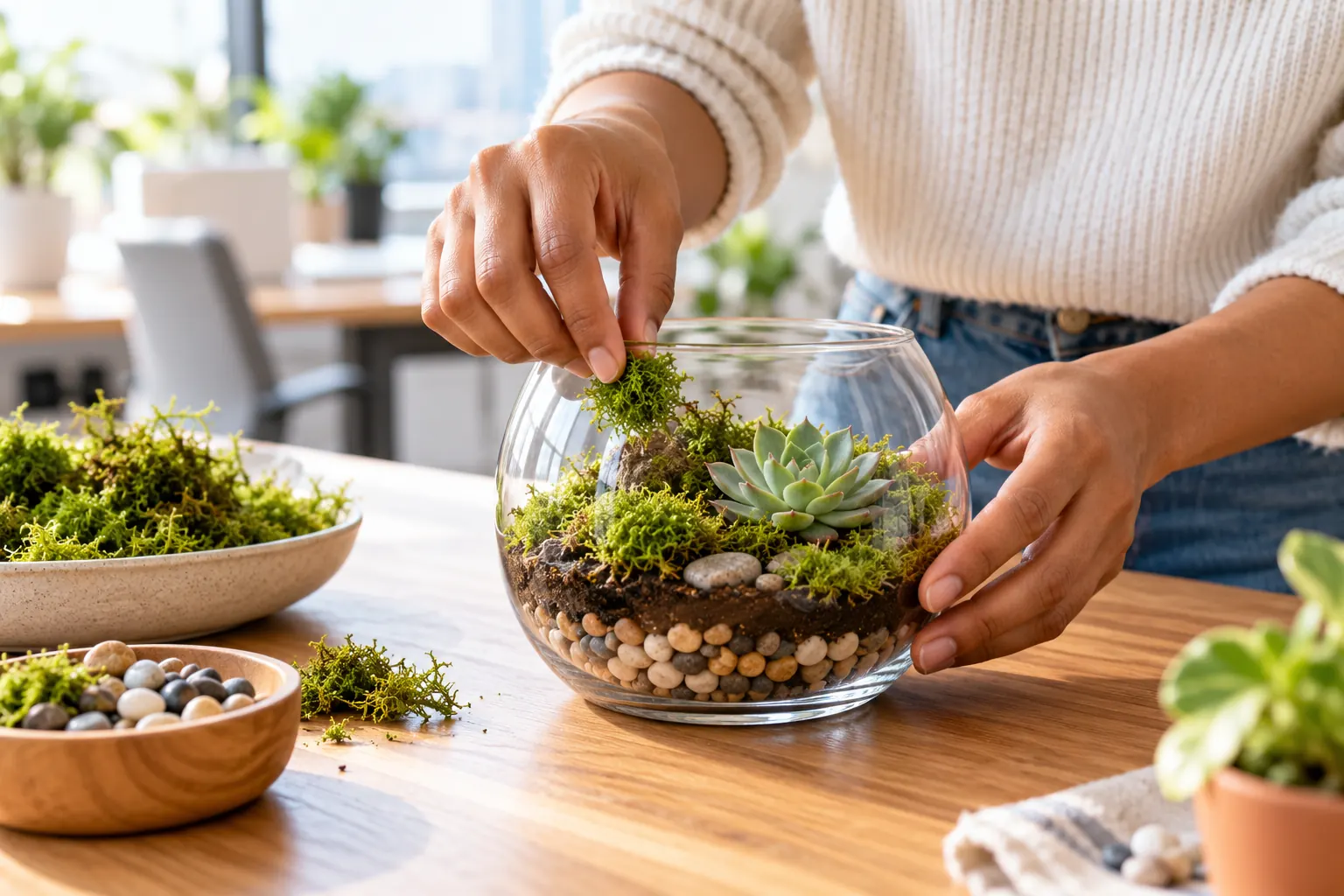
Facts are a good opener; a plant on every desk lasts longer. In our Terrarium Making workshop a host walks the team through building a terrarium with live greenery. Herb Gardening starts three herbs from seed, and Zen Garden is sand, stones and a tiny rake for a calm hour. Each is a 60-minute session on video, and the kit ships to each guest, so book about 16 days ahead.
Plant workshops, live prices: compare them on our virtual terrarium workshop page, or get a free quote.