20 teamwork challenges for work teams
A teamwork challenge is a short, timed task a small team can only finish together: build something, solve something or get a message across. Run teams of 4 to 6 and close with one debrief question.

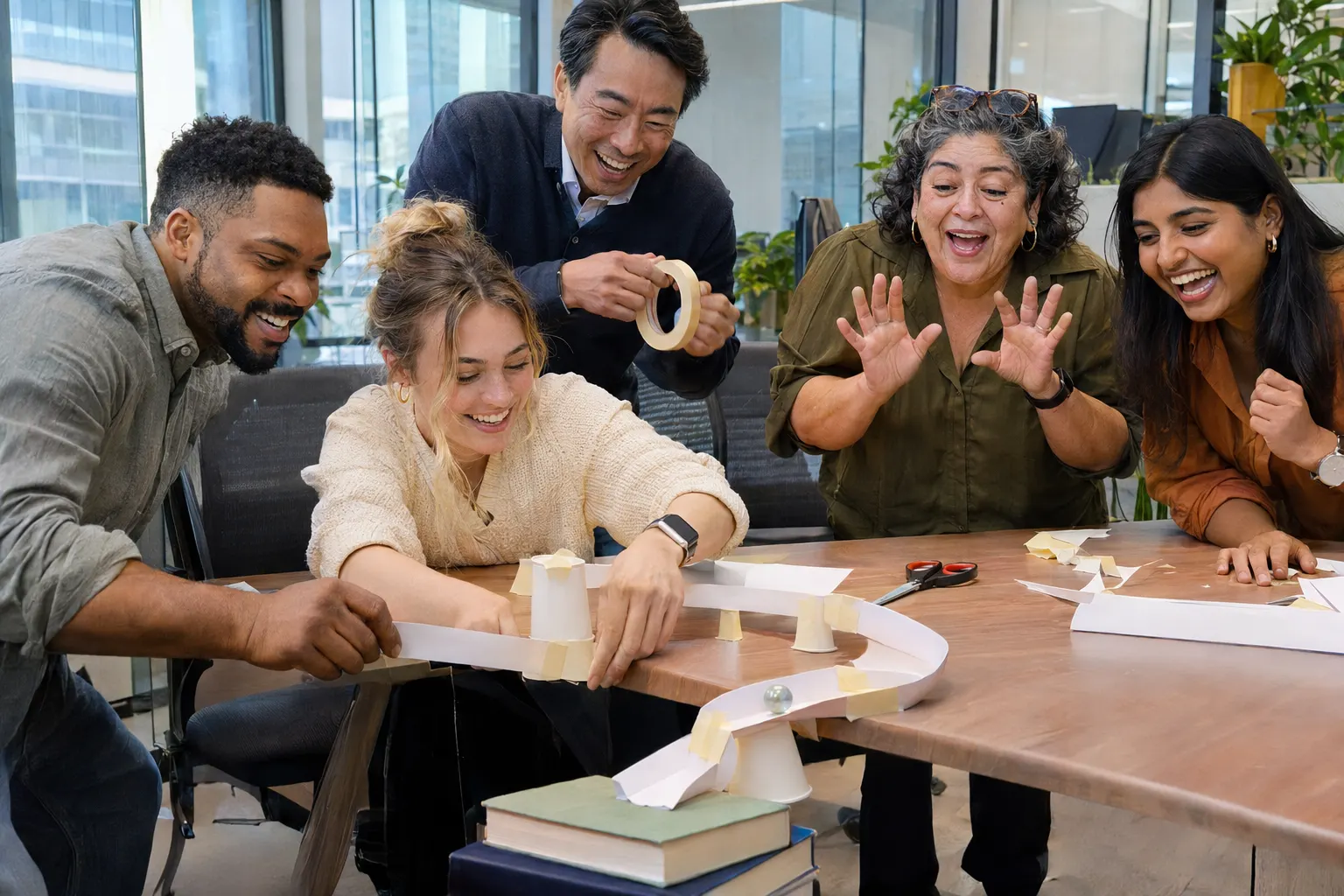
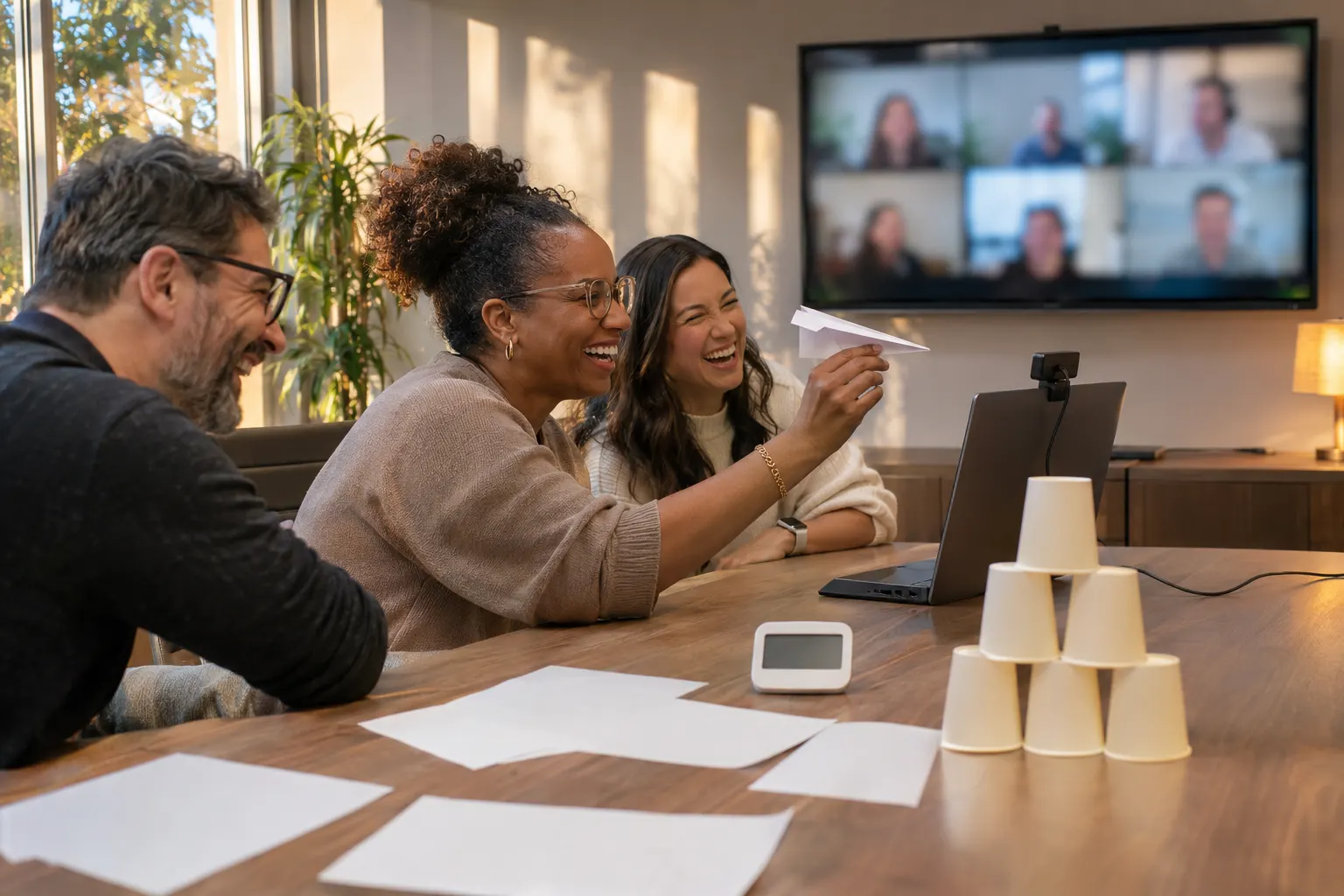
Here are 20 team challenges for work, each 5 to 25 minutes of play plus a quick debrief, in five groups: problem-solving, build, communication, creative and active. Every one lists its supplies (most need paper, tape or nothing), a version for video calls and a debrief question. Play one to open a meeting, or three in a row as a 45-minute team competition with the timer below.
Problem-solving team challenges
Seated, quiet to set up and easy to judge. Good for the middle of a meeting or a first challenge with a new group.
1. Shuffled steps · 15 min
Teams put the strips in order, write the missing step on a blank strip, then prove it by doing the task. First working paper cup wins.
- Supplies:
- A how-to for a simple task (folding a paper cup works) cut into 8 to 10 strips, with one strip removed.
- On video:
- Paste the steps into a shared doc in random order with one line deleted; each breakout room drags the lines into place.
- Debrief:
- Who spotted the missing step first, and what tipped them off?
2. Calendar crunch · 10 min
Teams place five meetings on five weekdays using only the clues. First team with the right week wins.
- Supplies:
- The five-clue puzzle below, printed once per team.
- On video:
- Share the clues on screen; teams solve in breakout rooms and post their week in chat.
- Debrief:
- Which clue did your team start with, and who suggested it?
3. Offsite on 100 points · 15 min
Each team plans a half-day offsite for 100 points or less. Everyone eats, remote teammates join at least one activity, and there is one quiet option. Each team pitches in 60 seconds and the room votes.
- Rooftop venue for the day: 40
- Office lounge, rearranged: 10
- Catered lunch: 25
- Pizza delivery: 12
- Hosted video game for everyone: 30
- Board games from the office shelf: 5
- Guided walk in a nearby park: 15
- Quiet craft table: 10
- Team photo with a photographer: 20
- Shuttle for the whole team: 25
- Supplies:
- The points menu here, printed or on a slide.
- On video:
- Same rules in breakout rooms, with the menu on a shared slide.
- Debrief:
- What did your team give up first, and who argued to keep it?
4. Make it worse · 10 min
Teams spend four minutes listing every way to make the weekly team meeting worse. Then they circle the ones that already happen and turn the top three into fixes.
- Supplies:
- Sticky notes, or a shared board with two columns.
- On video:
- A shared whiteboard: "worse" on the left, "fix" on the right.
- Debrief:
- Which worse idea got the biggest laugh, and is it already happening?
The Calendar crunch puzzle
Put these five meetings on five weekdays, one a day: budget review, client call, design sprint, hiring panel, team lunch.
- Nobody books the client call on a Monday.
- The team lunch is the day after the design sprint.
- The client call is earlier in the week than the budget review.
- The hiring panel can't be on Monday.
- The hiring panel is the day before the client call.
- Mon
- Tue
- Wed
- Thu
- Fri
Show the answer
Monday: Design sprint · Tuesday: Team lunch · Wednesday: Hiring panel · Thursday: Client call · Friday: Budget review
Monday can't hold the client call (clue 1), the hiring panel (clue 4), the budget review (it comes after the client call) or the team lunch (it follows the sprint), so the design sprint is Monday and the team lunch is Tuesday. The hiring panel and client call sit on back-to-back days with the budget review after both, so Wednesday is the hiring panel, Thursday the client call and Friday the budget review.
Team loves the puzzles? A hosted virtual escape room strings puzzles into a story against the clock, and a host keeps every team moving.
Want a host to run the challenge?
The challenges here suit a team of 8 to 30 with someone willing to run them. For a bigger group, a mostly remote team or an organizer who wants to play too, a live host brings the challenges, splits everyone into teams and breakout rooms, keeps score and announces the winner. Hosted team games book about 2 weeks ahead.
Live-hosted, about an hour, on Zoom (Teams, Google Meet or Webex on request). Today’s prices:
Team Discovery ChallengeStarting at $35 USD / person
Office OlympicsStarting at $39 USD / person
Scavenger Hunt with a Twist!Starting at $39 USD / person
Beach Vacate-tion Escape RoomStarting at $35 USD / person
Build challenges
Hands-on, a little noisy and the most fun to watch. Put a build challenge after lunch, when energy dips.
5. Slowest marble run · 20 min
Build a track from the tabletop to the floor. The run that takes longest without stopping wins. Three timed runs, the best one counts.
- Supplies:
- Per team: 10 sheets of paper, tape, 4 paper cups, scissors and a marble (a rolled foil ball works).
- On video:
- One teammate builds at home while the others direct on camera; swap the builder every five minutes.
- Debrief:
- When did your team stop adding ideas and start fixing one?
6. One fold each · 10 min
Each team builds one paper airplane, but every person makes exactly one fold, in turn, without talking. Three throws each; the longest flight wins.
- Supplies:
- A stack of paper and a tape line on the floor.
- On video:
- Each team picks one folder at home. Teammates give one instruction each, in turn, and the folder only follows.
- Debrief:
- How did you agree on a design without saying a word?
7. Three-step chain reaction · 25 min
Build a three-step chain reaction (a book tips, a pen rolls, a cup falls) that runs from one touch. Three tries for a clean run; teams that finish early add a fourth step.
- Supplies:
- Whatever is on your desks. Every teammate must add one item from their own desk.
- On video:
- Each person builds one step at home. Step one ends by rolling off one person's screen and step two starts on the next person's, in gallery order.
- Debrief:
- Whose desk item ended up doing the most work?
8. One-sheet chain · 10 min
Make the longest closed paper chain you can from a single sheet. Measure it stretched on the floor.
- Supplies:
- Per team: one sheet of paper, scissors and tape or a glue stick.
- On video:
- Everyone makes a chain from one sheet at home and the team adds up the lengths. One 60-second huddle halfway to share tricks.
- Debrief:
- What did you change after the first minute, and whose idea was it?
Want a full afternoon of events, medals and a leaderboard? Virtual Office Olympics turns challenges like these into a full hour of events, with a host keeping score across every team.
Communication challenges
No supplies, and they work as well on video as in a room. These are the ones people bring up in the next meeting.
9. Summary ladder · 10 min
Teams cut it to 50 words, then 20, then 6, keeping the action and the deadline. Another team judges whether the six words still say what to do.
- Supplies:
- One long email or memo, made up or a real one that isn't confidential.
- On video:
- A shared doc per team and a timer on screen.
- Debrief:
- What did you cut that you were sure you couldn't?
10. Count to twenty · 5 min
The team counts to 20 out loud, one voice at a time, in no set order and with no signals. If two people speak at once, start again at one. Best number in three minutes wins.
- Supplies:
- None.
- On video:
- Works as it is with mics on. Harder than in a room, which is the fun.
- Debrief:
- What changed between the first try and the best one?
11. Jargon buzzer · 15 min
Each person explains their current project in 60 seconds while teammates tap the table at every acronym or bit of jargon. Lowest team total wins. Then everyone tries again.
- Supplies:
- Paper and a pen per team to keep score.
- On video:
- Teammates type one letter in chat for each buzz, and the host counts.
- Debrief:
- Which word did we use most, and would a new hire know it?
12. Doodle recipe swap · 15 min
Each team secretly draws a doodle made of six simple shapes, then writes word-only instructions for it. Teams swap instructions, draw from them and compare with the original. One point per shape in the right place.
- Supplies:
- Paper and pens.
- On video:
- Breakout rooms for the drawing; swap instructions in chat and hold drawings up to the camera.
- Debrief:
- Which instruction caused the biggest mistake, and how would you rewrite it?
Creative team challenges
The challenges with the most laughs. Judge them by a room vote so nobody has to pick a winner.
13. Ten-minute ad · 15 min
Teams write and act out a 30-second ad for their object with a product name, a slogan and one made-up customer review. The room votes for the one they would buy.
- Supplies:
- One dull office object per team: a stapler, a tape dispenser, a mouse pad.
- On video:
- Each team shows its object from someone's desk and performs on camera.
- Debrief:
- Who had the idea the ad was built around?
14. Album cover for the quarter · 20 min
Teams invent a band name for themselves, draw the album cover for the last quarter and name three tracks after real moments from it.
- Supplies:
- Paper and markers.
- On video:
- A shared whiteboard, or one person draws on camera while the others direct.
- Debrief:
- Which track title should go on the team's wall?
15. Annoyance inventors · 15 min
Teams invent a product that fixes their annoyance, sketch it and pitch it in 60 seconds.
- Supplies:
- One card per team naming a small office annoyance: the printer queue, the meeting that could have been an email, the mystery item in the fridge.
- On video:
- Same in breakout rooms; sketches go up to the camera.
- Debrief:
- Is there a real fix hiding inside your invention?
16. Out-of-office contest · 10 min
Each team writes the funniest out-of-office reply it can for a made-up reason, like counting every plant in the building. Read them aloud and vote.
- Supplies:
- None.
- On video:
- Teams post their reply in chat and everyone votes with a reaction.
- Debrief:
- Which reply could you actually send to a customer?
Quick active challenges
Short and light on movement, standing or seated, so everyone can join. Use one to wake a room up between longer sessions.
17. Who leads the move? · 10 min
One guesser steps out. The team picks a secret leader who starts slow moves (a clap, a shoulder roll) that everyone copies, changing every 15 seconds. The guesser gets three guesses to find the leader.
- Supplies:
- None.
- On video:
- The guesser turns away from the camera while the leader is picked by private message. Gallery view makes it harder.
- Debrief:
- How did the team hide the leader, and how did the guesser find them?
18. Sixty-second sync · 5 min
Everyone stands, closes their eyes and sits down when they think 60 seconds have passed. The timekeeper notes the first and last. The smallest gap wins; in round two, teams may agree on a counting plan first.
- Supplies:
- A stopwatch.
- On video:
- Cameras on; everyone lowers a raised hand at their 60.
- Debrief:
- Did your plan help, or did one confident counter carry the team?
19. Spell it with bodies · 10 min
The host calls a short word (TEAM, GO, WIN) and each team spells it standing or on the floor. First clear photo wins the point.
- Supplies:
- A phone for the photo.
- On video:
- Each person makes one letter with their arms, in word order, one after another, while a teammate takes screenshots.
- Debrief:
- Who took charge of the layout, and was that the plan?
20. Move memory chain · 10 min
The first person does one move, like a wave or a stretch. The next repeats it and adds one. The team keeps the chain going as long as it can; longest chain wins.
- Supplies:
- None.
- On video:
- Works the same in gallery view, in the order of the tiles.
- Debrief:
- What helped the team remember the whole chain?
For moving around with a purpose, a hosted virtual scavenger hunt sends teams racing the clock to find items and finish tasks, with a host on the call.
Challenge timer for the screen
Pick a challenge and share this card: the rules and supplies stay on screen while the clock runs, and the debrief question is waiting when time is up.
Shuffled steps
Teams put the strips in order, write the missing step on a blank strip, then prove it by doing the task. First working paper cup wins.
Supplies: A how-to for a simple task (folding a paper cup works) cut into 8 to 10 strips, with one strip removed.
15:00
Debrief question: Who spotted the missing step first, and what tipped them off?
How to run a 45-minute team competition
Three challenges of different types, so the planners, the builders and the performers each get a round.
- 5 minMake teams of 4 to 6, mixing departments, and name them
- 5 minRound 1, a warm-up: Count to twenty or Sixty-second sync
- 12 minRound 2, a head start for planners: Calendar crunch or Shuffled steps
- 15 minRound 3, the showpiece: Ten-minute ad or One fold each
- 3 minScores and the winner
- 5 minDebrief: one question from the challenge everyone liked most
Rules that keep it fair
- Teams of 4 to 6. Smaller and someone carries it; bigger and someone checks out.
- Mix the teams. Split up people who sit together every day. That is half the point.
- Points: 3, 2, 1. Three points for first, two for second, one for everyone else who finished.
- Name a judge and a timekeeper. Two people who don't play keep it fair and moving.
- Keep movement optional. Anyone can play an active round seated or take the judge's seat instead.
- Small prizes, never cash. First pick of the next team lunch spot, or the round-two build as a desk trophy.
In the office, hybrid or on video
- In the office: One table per team, supplies in a bag on each table, and the timer on the meeting room screen.
- Hybrid: Put remote people on mixed teams with an office buddy who holds the laptop at the table, and pick challenges with a video version.
- On video: Breakout rooms per team, the challenge timer on this page shared on screen, and supplies listed in the invite a week ahead.
Running it for 50 or more people? Pick from our team building for large groups, or let a host run virtual team games with every team playing at once. For more ideas, see our team building games, problem solving activities and minute to win it games.