Kwanzaa activities and ideas for work
Seven days, seven principles, one candle a day. Here is how Kwanzaa is celebrated, and how a team can mark it well.

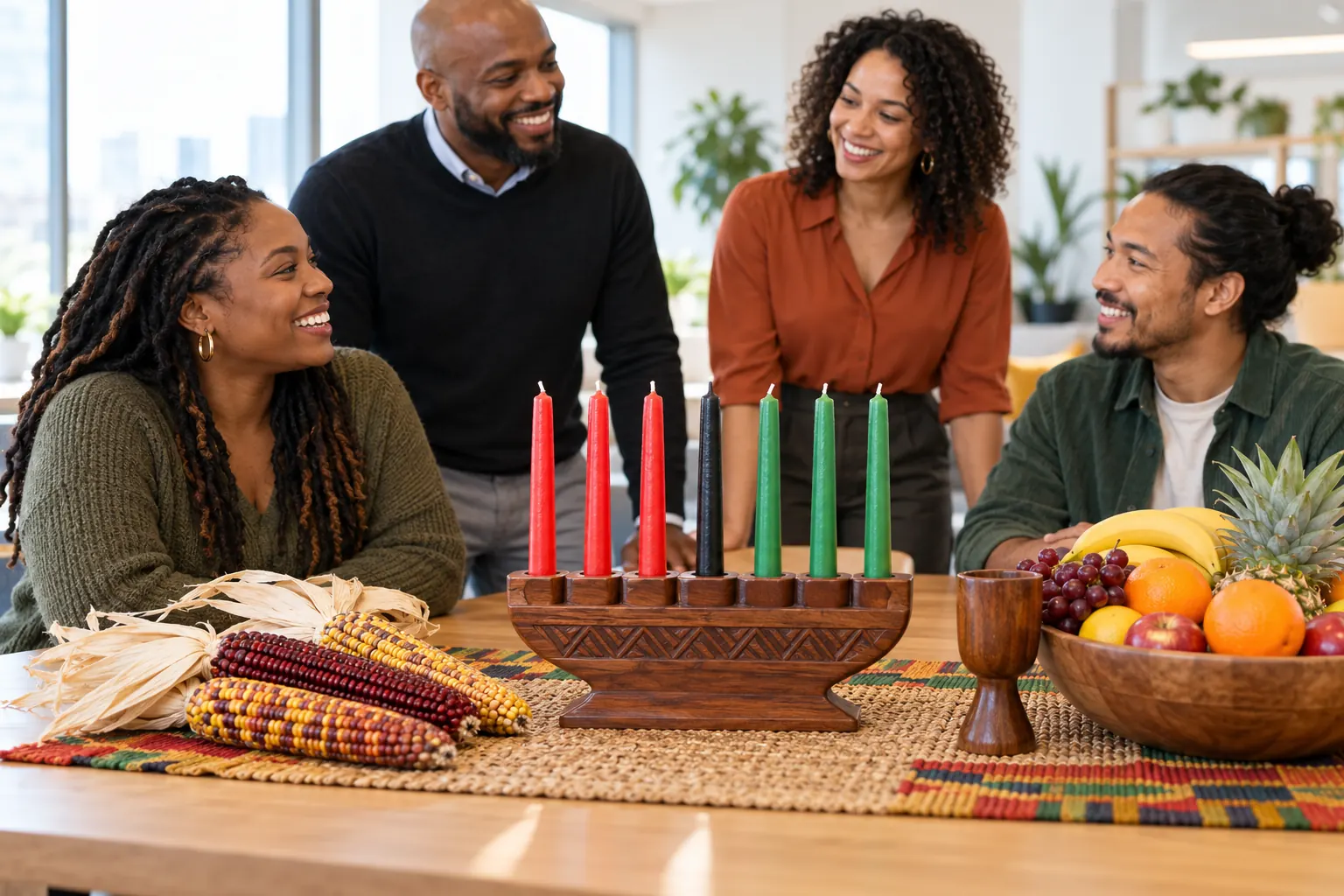
The best Kwanzaa activities for work are small, optional and tied to one of the holiday’s seven principles: a unity check-in, a volunteer shift, a craft hour. Kwanzaa is a week-long African American cultural celebration, held every year from December 26 to January 1. Below: what it is, how to celebrate Kwanzaa, its dates and principles, 21 activities (three for each principle), 15 trivia questions, and how to include it without overstepping.
What is Kwanzaa?
Kwanzaa was created in 1966 by Dr. Maulana Karenga, during the Black Freedom Movement, as a celebration of family, community and culture for African Americans. Its name comes from the Swahili matunda ya kwanza, “first fruits,” after African harvest festivals.
The official Kwanzaa site calls it “not a religious holiday, but a cultural one with an inherent spiritual quality,” and people of many faiths keep it alongside their own holidays. These are its seven basic symbols and two supplemental ones:
- Mazao (the crops)
- African harvest celebrations and the rewards of productive and collective labor.
- Mkeka (the mat)
- Tradition and history, the foundation on which everything else is built.
- Kinara (the candle holder)
- Roots, and the parent people of African Americans: continental Africans.
- Muhindi (the corn)
- Children and the future they embody.
- Kikombe cha Umoja (the unity cup)
- The principle and practice of unity, “which makes all else possible.”
- Mishumaa Saba (the seven candles)
- The Nguzo Saba, the seven principles at the heart of the week.
- Zawadi (the gifts)
- The labor and love of parents, and the commitments children make and keep.
- Bendera (the flag, supplemental)
- Black for the people, red for their struggle, green for the future that comes from it.
- Nguzo Saba poster (the seven principles, written out, supplemental)
- The official site says some written form of the principles should always be part of the set.
How to celebrate Kwanzaa
Every household does it a little differently, but these are the traditions the official site and most families share.
- Set the symbols on a mkeka: crops, corn, the kinara with its seven candles, the unity cup and the gifts.
- Light one candle each day. The black candle in the center comes first, on December 26, then the rest are lit “from left to right” on the following days, in the official site's words. Each day's candle is its principle's, so red and green alternate.
- Greet each other with “Habari gani?” (“What's the news?”). The answer is the day's principle: “Umoja” on day one, and so on.
- Spend each day on its principle, with readings, music, stories and talk about what it asks of you.
- Share the karamu, a community feast with food, music and dance, on December 31.
- Give gifts mainly to children. The official site says they should always include a book and a heritage symbol.
- Spend January 1, the Day of Meditation (Siku ya Taamuli), on three questions: “Who am I; am I really who I say I am; and am I all I ought to be?”
The unity cup (kikombe cha umoja)
The Kwanzaa unity cup stands for unity, which the official site calls the principle “which makes all else possible.” In many homes and community events it holds the libation, tambiko, poured in honor of the ancestors, often at the karamu and led by an elder. At work, keep it as a symbol on the display: no shared drinking, and no alcohol.
When is Kwanzaa? Dates for the next five years
Kwanzaa keeps the same dates every year: December 26 to January 1. Only the weekdays move.
| Kwanzaa | Starts | Ends |
|---|---|---|
| 2026 | Sat, Dec 26 | Fri, Jan 1, 2027 |
| 2027 | Sun, Dec 26 | Sat, Jan 1, 2028 |
| 2028 | Tue, Dec 26 | Mon, Jan 1, 2029 |
| 2029 | Wed, Dec 26 | Tue, Jan 1, 2030 |
| 2030 | Thu, Dec 26 | Wed, Jan 1, 2031 |
In 2026, Kwanzaa runs from Saturday, December 26 to Friday, January 1, 2027. The karamu feast falls on Thursday, December 31.
When to mark it at work
Kwanzaa falls in the week most offices close. Approve time-off or schedule requests for that week as you would for any holiday, and pick one of three windows for a team moment:
- The week before the break. Fold a short Kwanzaa moment into the December party or the last team meeting, while everyone is still online.
- A voluntary drop-in during the week. If colleagues who celebrate want to host one, a 30-minute video call on one principle, with no attendance taken.
- The first week back. Imani and the Day of Meditation fit January goal-setting, and Black History Month follows in February.
The seven principles of Kwanzaa (Nguzo Saba)
Each day honors one principle, and its candle is lit that day. The definitions below are the official ones, word for word.
Umoja (Unity)Day 1, Sat, Dec 26
“To strive for and maintain unity in the family, community, nation, and race.”
The black candle, in the center
Kujichagulia (Self-Determination)Day 2, Sun, Dec 27
“To define ourselves, name ourselves, create for ourselves and speak for ourselves.”
A red candle
Ujima (Collective Work and Responsibility)Day 3, Mon, Dec 28
“To build and maintain our community together and make our brother's and sister's problems our problems and to solve them together.”
A green candle
Ujamaa (Cooperative Economics)Day 4, Tue, Dec 29
“To build and maintain our own stores, shops and other businesses and to profit from them together.”
A red candle
Nia (Purpose)Day 5, Wed, Dec 30
“To make our collective vocation the building and developing of our community in order to restore our people to their traditional greatness.”
A green candle
Kuumba (Creativity)Day 6, Thu, Dec 31
“To do always as much as we can, in the way we can, in order to leave our community more beautiful and beneficial than we inherited it.”
A red candle
Imani (Faith)Day 7, Fri, Jan 1
“To believe with all our heart in our people, our parents, our teachers, our leaders and the righteousness and victory of our struggle.”
A green candle
21 Kwanzaa activities for work, three per principle
Pick one or two, not all twenty-one. Every idea is opt-in, works for a team where only a few people celebrate, and asks nobody to perform a ritual that isn't theirs.
Umoja (unity)
1. Habari gani check-in
Open the last team meeting of the year with the Kwanzaa greeting, explain that the answer on day one is Umoja, then go round: one moment this year when the team pulled together.
10 minutes, any size. Works on video.
2. Unity lunch
A shared lunch where anyone can bring a dish that means family to them, with a small card naming it. Serve it in individual portions and label allergens.
An hour at lunch. Cards and markers.
3. Kwanzaa display
If colleagues who celebrate would like to, they set out a Kwanzaa set in the lobby with a card for each symbol. Use electric candles or leave them unlit.
Set up in an hour; leave it out for the week.
Kujichagulia (self-determination)
4. Name your own year
Each person writes a title for their coming year and one goal in their own words, then shares only if they want to.
15 minutes. Index cards or a shared doc.
5. Employee-led one-on-ones
For the first one-on-one of January, the employee sets the whole agenda and the manager only asks questions.
30 minutes per pair. No prep for managers.
6. Own-words profiles
Invite everyone to rewrite their internal directory bio in their own voice: their name as they say it, their pronouns if they like, and what they want to be asked about.
10 minutes each, done at their desk.
Ujima (collective work and responsibility)
7. Team volunteer shift
Book a shift with a local food bank or a Black-led community group, picked with your Black employee resource group if you have one.
2 to 3 hours. Book a few weeks out; December slots go first.
8. Fix-it hour
The team picks one shared annoyance, a slow handoff or a broken template, and solves it together in an hour.
One hour, 4 to 12 people. A whiteboard.
9. Skill swap
Volunteers teach a 10-minute skill to the group, from a spreadsheet shortcut to a family recipe.
45 minutes for three or four teachers.
Ujamaa (cooperative economics)
10. Black-owned vendor list
Start a shared list of Black-owned caterers, printers and gift makers near your offices, and use it for next year's orders.
A shared doc, added to all year.
11. Cater the party from a Black-owned business
Order the December party food from a Black-owned restaurant or bakery, and name them on the menu card.
Order 2 weeks ahead for December dates.
12. Book club from an independent Black-owned bookstore
Pick January's book club title and buy the copies from an independent Black-owned bookstore.
Order before the break so books arrive by week one.
Nia (purpose)
13. One-sentence team purpose
Each person drafts one sentence on why the team exists, then the group merges them into one line for the new year.
30 minutes. Sticky notes or a shared board.
14. Why I do this work
In the last meeting before the break, a few volunteers take two minutes each on what keeps them in their field.
15 minutes. Ask volunteers a day ahead.
15. Mentoring pledges
Senior people pledge a few mentoring hours for the new year, and anyone can sign up for one before January ends.
A sign-up sheet. January is National Mentoring Month.
Kuumba (creativity)
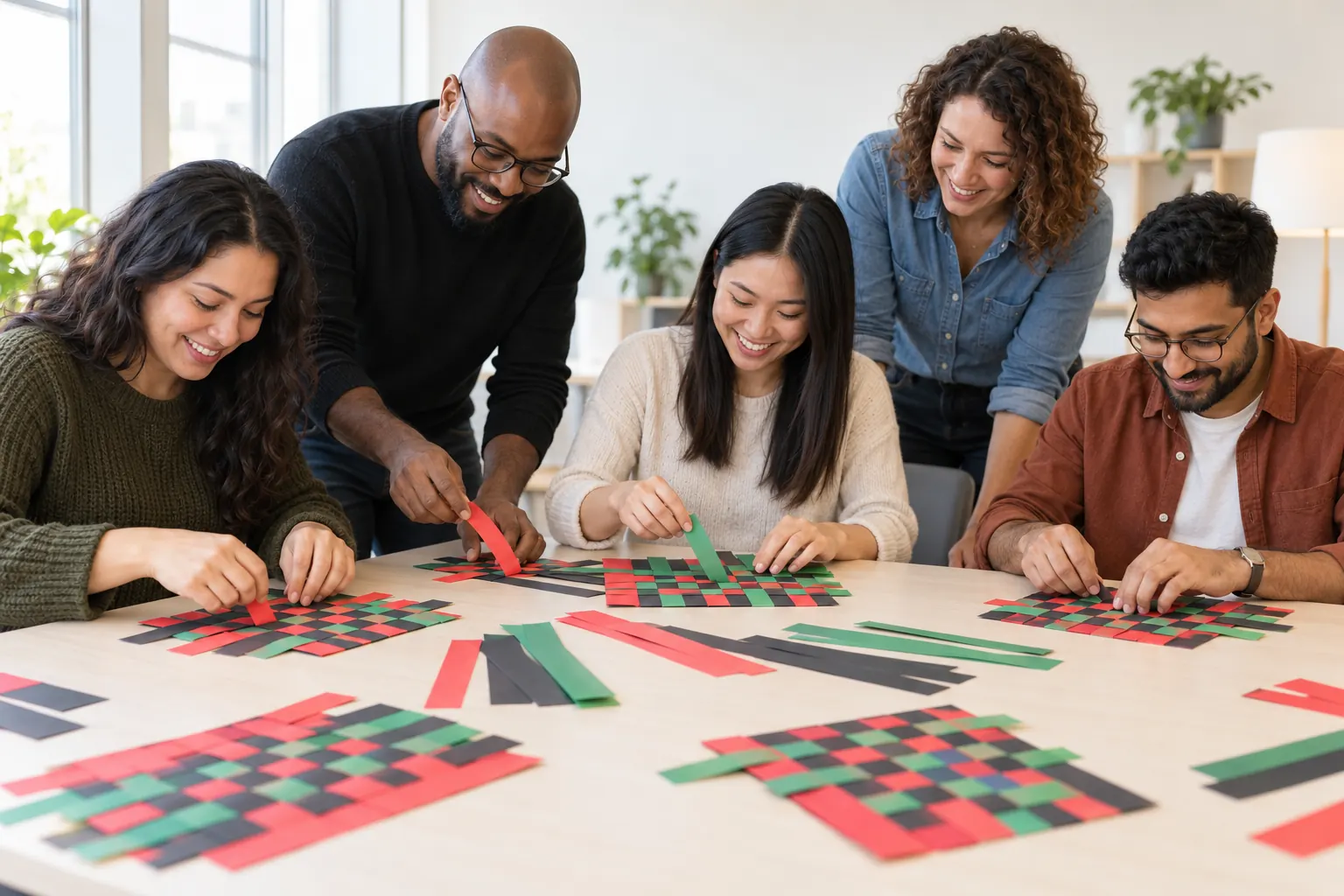
16. Paper mkeka weave
Cut slits in a sheet of paper, then weave strips of black, red and green through them to make a small mat.
30 minutes. Construction paper, scissors, glue.
17. Leave it more beautiful
Take the Kuumba definition literally: spend an hour making one shared space better, a plant refresh, a cleaned-up wiki or a new art wall.
One hour. A small budget for supplies.
18. Poem at stand-up
Each day of the last week, one volunteer reads a short poem by a Black poet, such as Langston Hughes, Gwendolyn Brooks or Lucille Clifton.
2 minutes a day.
Imani (faith)
19. Thank someone who believed in you
Everyone names a teacher, parent or early boss who believed in them, and a few people send that person a note.
15 minutes as a group.
20. Letters to next year's team
Each person writes a short note on what they believe the team will pull off next year. Seal them and open them next December.
15 minutes. Envelopes or a private doc.
21. Day of Meditation prompt
In the first week back, share the three questions of January 1 as a private journaling prompt, credited to the Kwanzaa tradition. Nobody shares answers.
5 minutes to send. Nothing to collect.
15 Kwanzaa trivia questions and answers
Read them aloud at the December party, or post one a day through the week. Tap to show each answer.
1. In what year was Kwanzaa first celebrated?
Show answer
1966.
2. Who created Kwanzaa?
Show answer
Dr. Maulana Karenga.
3. How many days does Kwanzaa last?
Show answer
Seven, from December 26 to January 1.
4. What is the mkeka?
Show answer
The mat that every other Kwanzaa symbol sits on, standing for tradition and history.
5. Why are the Kwanzaa words in Swahili?
Show answer
It's a pan-African language, chosen to reflect the whole of Africa rather than one group or nation.
6. What is the Swahili name for the seven principles?
Show answer
Nguzo Saba.
7. What are the seven Kwanzaa candles called in Swahili?
Show answer
Mishumaa saba.
8. How many of the seven candles are red?
Show answer
Three, with three green and one black.
9. Which candle is lit on the first day?
Show answer
The black one, in the center, for Umoja (unity).
10. What is the answer to the greeting “Habari gani?”
Show answer
The principle of the day, so “Umoja” on December 26.
11. Which principle means creativity?
Show answer
Kuumba, honored on December 31, the sixth day.
12. According to the official Kwanzaa site, what two things should gifts always include?
Show answer
A book and a heritage symbol.
13. What does the green on the Kwanzaa flag stand for?
Show answer
The future, the one that comes from the struggle. Black is the people and red the struggle.
14. Which Kwanzaa symbol stands for children?
Show answer
Muhindi, the corn.
15. What is January 1, the last day of Kwanzaa, called?
Show answer
The Day of Meditation, Siku ya Taamuli in Swahili.
Running a quiz in February too? Our Black History Month trivia is ready to read aloud.
How to mark Kwanzaa at work respectfully
Making room for Kwanzaa is the goal, not making it the office's own. Seven rules for whoever is planning:
- Invite, never assign. Ask colleagues who celebrate whether they would like the office to mark it, and how. Don't assume a Black colleague celebrates, or ask one person to speak for everyone. If they'd rather it stayed private, keep it to a greeting.
- Let people who celebrate lead the rituals. The official site puts it plainly: “Audience attendance is one thing; conducting a ritual is another.” Without a volunteer from the community, keep the session educational.
- Call it what it is. A cultural holiday, not a religious one and not a substitute for Christmas. People of many faiths celebrate it, often alongside their own holidays.
- No shared cup, no alcohol, no open flame. Show the unity cup as a symbol, give people their own cups for any toast, and use electric candles where real ones aren't allowed.
- Skip costumes and clip art. No “dress African” days and no generic safari decor. The colors are black, red and green; use them simply.
- Keep it about values, not shopping. The founders warn against turning Kwanzaa into another shopping holiday. Buying from Black-owned businesses fits Ujamaa; a branded Kwanzaa sale does not.
- Pay the people you ask to speak. If you invite an outside speaker or a colleague prepares a talk, pay a fee or count it as real work.
At an inclusive holiday party
- Name the season, not one holiday: “winter party” or “end-of-year celebration”.
- Add Kwanzaa to the holiday greeting card or message, with the dates.
- Put one Kwanzaa round in the party trivia, using the questions above.
- Set a small display of the symbols beside the other holidays' decor, not in a corner of its own.
More on planning the season in our inclusive holiday party ideas, the same care for another December holiday in Hanukkah activities for work, and ideas for February in Black History Month team building.
Run it with a host
Kwanzaa itself belongs to the people who celebrate it. For the all-team party around it, a hosted virtual holiday party gives everyone an hour together. Games run on Zoom by default (Teams, Google Meet or Webex on request), book about 2 weeks ahead, and can run as two sessions for a team split across time zones. December dates fill first.
An inclusive holiday game hour, a creative kit class, and trivia for February, with today’s prices.
Holiday Fun & Games is a live-hosted hour of seasonal games and trivia with light nods to Christmas, Hanukkah, Kwanzaa and New Year’s, so no one holiday takes over. Candle Making ships a kit to each guest for a calm, Kuumba-style creative hour; book it at least 16 days ahead (3 to 4 weeks for international addresses). Black History Trivia & Games carries the same spirit into February, and our heritage month events cover the rest of the year. Hybrid team? Run an in-person game in the office plus a virtual session for remote staff, or one virtual party for everyone. Get a free quote with your date and headcount.