Free memory game: match the pairs, solo or in teams

0 moves0:00
Find every pair
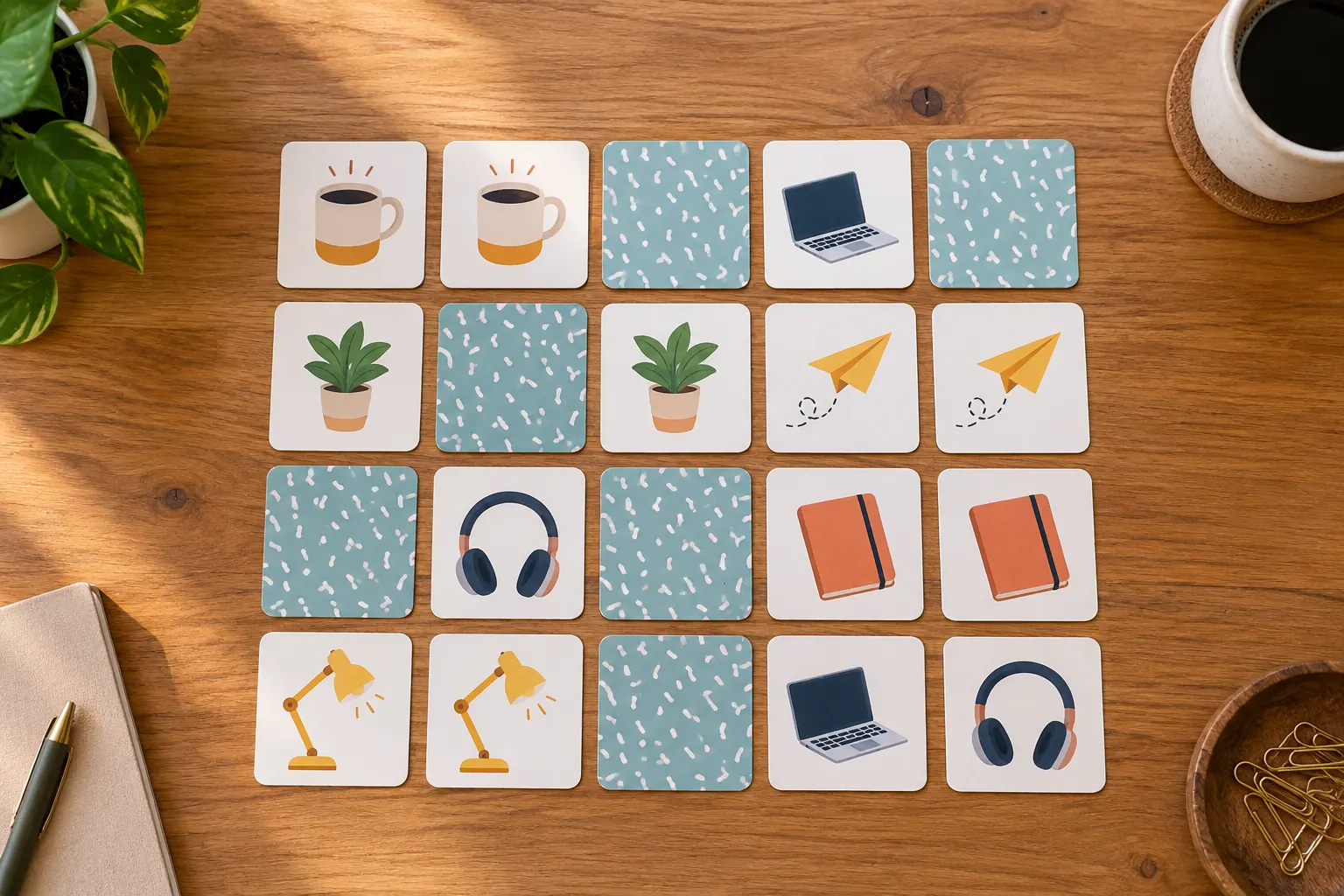
This free memory game is the classic card matching game with a work twist: 18 office pictures, from coffee cups to paper planes, hidden under numbered cards. Flip two at a time and find every pair in as few moves as you can. It takes about two minutes on 8 pairs, which makes it a good break between tasks, and the Teams mode turns it into a contest for a team meeting. Below: the rules, how to run it on a video call, five memory games that need no screen at all, and how to make your own word matching game.
How to play the memory game
The rules fit on an index card. The skill is in remembering where you saw what.
- Pick a board. 8 pairs is a two-minute round, 12 pairs a proper game, 18 pairs a real test.
- Flip two cards. Tap one card, then another. Each pair of flips counts as one move.
- Match them or remember them. Two of the same picture stay face up. Two different ones turn back over after a moment.
- Clear the board. The game ends when every pair is face up. Your time and moves show, and your best of the session stays on screen.
- Go again. New game deals a fresh board, never the same layout twice in a row.
Five tips for fewer moves
- Work row by row. Flipping cards in order makes positions easier to remember than jumping around.
- Say the picture out loud. "Rocket, card 7." Naming it gives your memory a second hook.
- Use the numbers. Every card back has a number. Remember "key on 3 and 14" instead of a vague spot.
- Flip the unknown card first. If it matches one you've seen, you know exactly where to go next.
- Don't waste a known card. When you already know where both halves of a pair are, take that match before exploring.
How to play memory as a team game on a video call
Two teams, one shared screen and a scoreboard. It works on Zoom, Microsoft Teams and Google Meet, and it needs no prep at all.
- Split into two teams. Any size works. Odd numbers are fine; the teams just take turns.
- Share the screen. The host opens this page, shares the browser tab and picks Teams. 12 pairs is a good size for a call.
- Call out numbers. The team on turn names two card numbers, "9 and 21," and the host flips them.
- A match keeps the turn. Find a pair and your team goes again. Miss and the turn passes; the scoreboard shows whose go it is.
- Let everyone help. Teammates can shout advice, but one rotating captain makes the final call each turn so the quiet people get a say.
- Play best of three. A round takes five to ten minutes. Switch which team starts each round.
It slots into the first ten minutes of a team meeting. For more short games like it, see our team meeting games, or try guessing games for the same easy competition with no screen sharing.
5 memory games to play at work without this page
Good memory games for work need no card deck and little or no prep. Each one works in a meeting room, and most work on a call.
1. The office packing chain
The first person says "I went to the office and packed a laptop." The next repeats the whole list and adds one item, and so on around the group. Miss or mix up an item and you sit out; the last one left wins. For a harder round, the items must go in alphabetical order. On a call, go in the order of the participant list.
4 to 12 players · 10 minutes · Nothing needed
2. Slideshow recall
Show 12 everyday photos for five seconds each: a desk, a street corner, a fridge shelf. Then ask eight detail questions, like "How many mugs were on the desk in photo 3?" Teams answer together and the most correct answers wins. Use your own photos, so every detail is something you can check.
5 to 50 players · 10 minutes · A slide deck
3. Grid swap
Make a slide with a 4 by 4 grid of simple pictures, columns A to D and rows 1 to 4. Show it for 20 seconds. Then show the same grid with three squares swapped. Teams write down which squares changed, like "B2 and D4." Play three rounds and add a swap each time.
4 to 40 players · 10 minutes · Two slides per round
4. Number ladder
Read out four random digits once, at a steady pace. Everyone writes them down from memory. Next round, five digits, then six. Score a point for every line you get exactly right, and stop when nobody gets the round.
Any size · 5 to 10 minutes · Pen and paper
5. Follow the pattern
The first person does three quick moves: tap the desk, thumbs up, touch your ear. The next person copies the pattern and adds one move. Keep going until someone breaks the chain, then start a new pattern with them. On a call, everyone keeps their camera on and plays in participant order.
4 to 15 players · 5 minutes · Nothing needed
Number ladder and grid swap also make quick memory test games for a training day. Want more quick competitions? Our minute to win it games include a memory tray round, and these office desk games work without leaving your chair.
Make your own word matching game for work
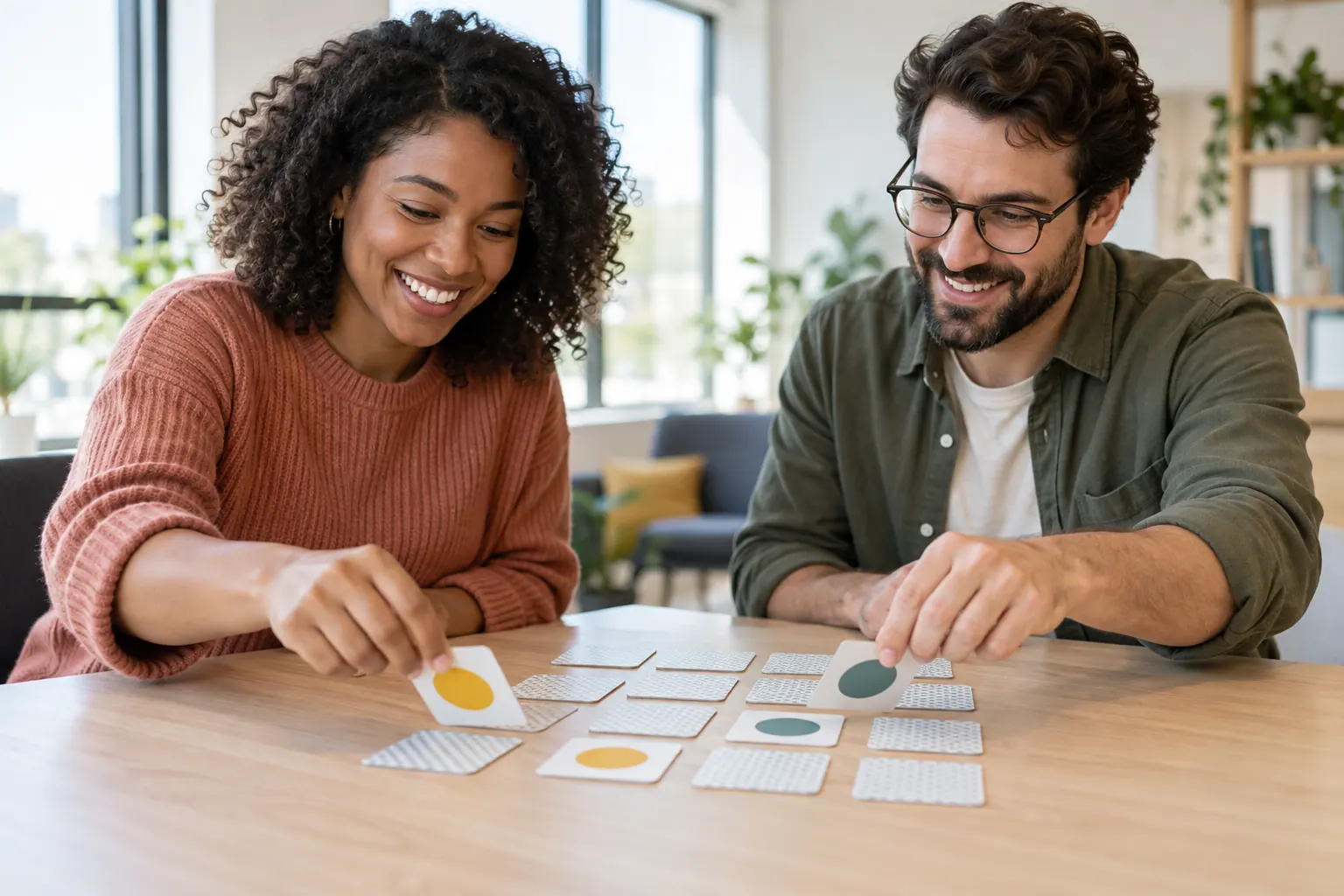
A word matching game pairs a term with its meaning instead of two identical pictures. Word matching games made from a stack of index cards become a training tool that people actually enjoy.
Eight pairs that work at work
- Acronyms and what they stand for. A natural onboarding game: new hires learn the alphabet soup in ten minutes.
- Teams and what each one owns. Who handles invoices, who fixes the website, who books travel.
- Products and the problem each one solves. Good for sales and support teams, and for everyone else to learn the lineup.
- Company milestones and their year. First customer, first office, first hire outside the founders.
- Internal tools and what they're for. Pair each tool's name with a one-line job: "where we file expenses."
- Emoji and the chat channel each one stands for. A quick laugh for a team that lives in chat.
- Pets and their owners. Opt-in photos only. People who don't have a pet, or don't want to share, simply skip it.
- Training terms and their definitions. Turns a safety or compliance refresher into five minutes of play.
How to make and play it
- Write the pairs on index cards. Terms on one color, answers on another. 8 to 12 pairs is plenty.
- Lay them face down in two grids. One grid per color, so every turn is one card from each.
- Take turns flipping one of each color. Read both out loud. A correct pair is yours to keep; a wrong one goes back face down.
- Most pairs wins. Then shuffle and play again with the cards nobody got right first.
Can memory games improve your memory?
Looking for memory games to improve memory? Here is the honest version, without the brain-training hype.
A matching game is one of the simplest working memory games: it asks you to hold on to where you saw the rocket a few seconds ago. Play it often and you will get better at it. Whether that carries over to remembering names, deadlines or where you parked is a different question, and nobody should promise you it does. We make no medical claims here.
What a round reliably gives you is smaller and still worth having: two minutes of attention on something other than your task, a small win, and in the team version, a reason to laugh with coworkers. Pair it with a work rhythm that has breaks built in, like our free Pomodoro timer, and it fits the five-minute break nicely.
