Escape room tips: how to beat an escape room as a team
What to do before, during and after the room, so your team gets out in time. Works for a real room with padlocks and a virtual one on Zoom.

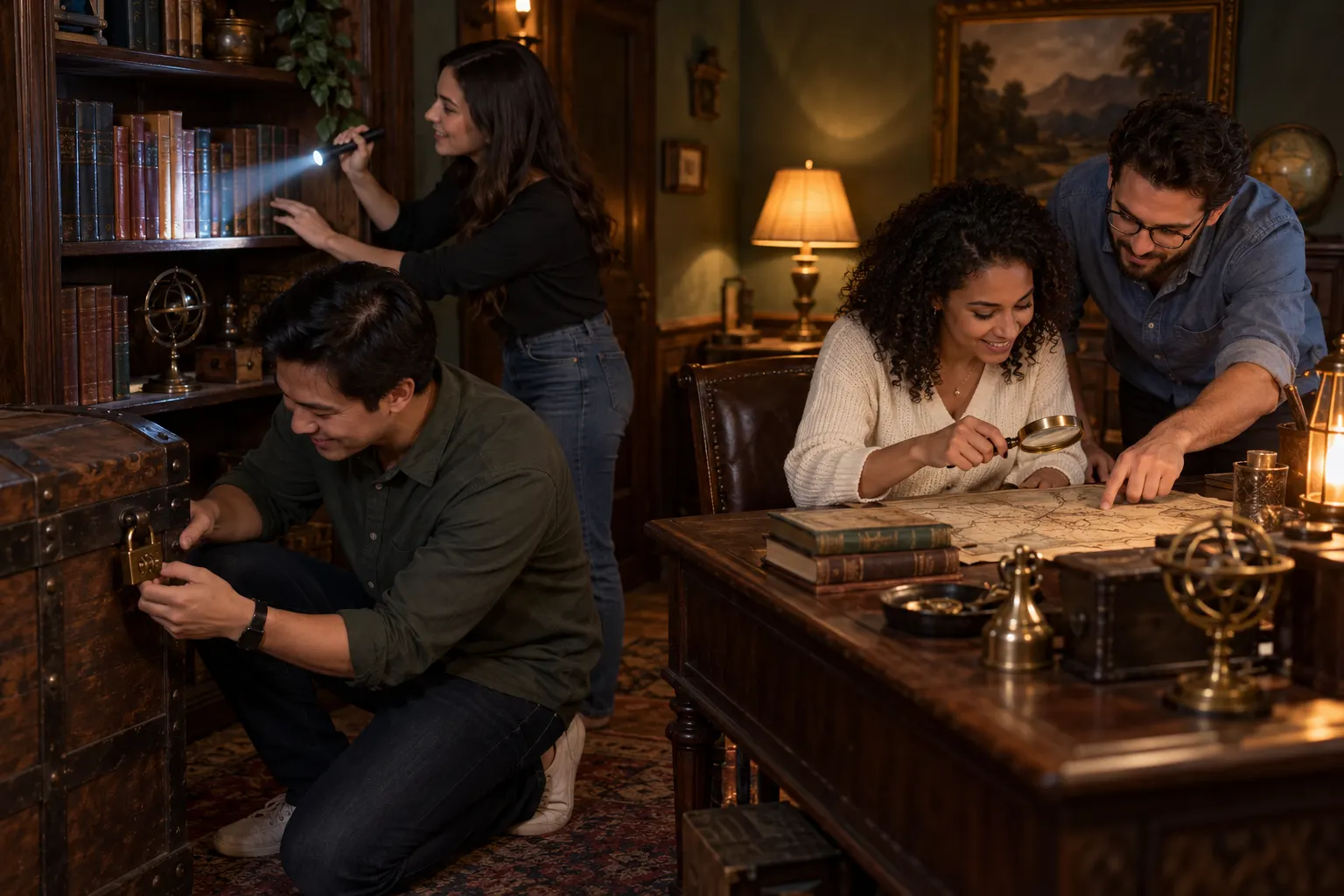
These escape room tips are for a work team going in together, whether it is your first room or your fifth. Most rooms give you about an hour, and teams rarely run out of brains first: they run out of time because a key sat in someone’s pocket or two people worked the same lock. How to beat an escape room comes down to a good first five minutes, clear roles, saying every find out loud and taking hints before the clock makes you panic. There is a one-page briefing to print below.
Escape room tips for beginners: before you go
- Book for your headcount. Each room lists a player range. Over about eight people, book two rooms at the same time and race.
- Pick by difficulty, not by theme. Ask the venue which room first-timers finish most often. A beaten room is a better team outing than a cool poster.
- Arrive 15 minutes early. There may be waivers, lockers and a briefing, and some venues start the clock at the booked time whether you are there or not.
- Mix the work groups. Split up the people who sit together every day, and put managers on a team they don't lead at work.
- Dress to kneel. Comfortable clothes and shoes, nothing in your hands. Half the clues sit low or under something.
- Keep the drinks for afterward. Puzzles need a clear head. Book the bar or the dinner for after the room, not before.
Four questions to ask at the briefing
- How many hints do we get, and do they cost us time?
- Is anything in here off-limits, and how is it marked?
- Can a key or a code be used more than once?
- How do we call you for a hint: a walkie-talkie, a button or out loud?
The first five minutes
The start decides most games. Do these in order before anyone settles on one puzzle.
- Hear the whole story. The briefing usually names the goal, and sometimes the first clue is hidden in it.
- Sweep the room in pairs. Two minutes, each pair on a different wall. Touch, open and lift everything that isn't marked off-limits.
- Bring every loose item to one table. Keys, papers, cards and odd objects all go to the same spot, so nothing sits forgotten in a corner.
- Count the locks out loud. Name each one by type and size: three digits, four digits, letters, arrows, key. Write the list down.
- Start with the most obvious match. A key on the table and one keyhole in the room is your first move. Early wins get the whole team talking.
How to search an escape room
- Look under, behind and inside. Table undersides, drawer backs, book pages, coat pockets and picture frames.
- Respect the stickers. Many rooms mark off-limits items with a sticker or tape. Those are never part of the game.
- Never force anything. If it takes strength, it isn't a puzzle. Ask the game master before you pull harder.
- Leave the ceiling and the electrics alone. Clues sit within reach; outlets, vents and light fittings are almost always off-limits.
- Swap searchers on each corner. A second person searching the same spot finds what the first one missed.
- Shine your light at an angle. A flashlight held low across a surface shows scratches, dents and faint writing.
Escape room strategies: roles for a work team
People settle into roles anyway. Naming them at the door stops two people doing one job while nobody does another.
- The searcher. Works every corner and brings each find straight to the table.
- The keeper. Runs the table: unused items on one side, finished ones in a done pile.
- The lock tester. Tries every code the team calls out and says the result out loud.
- The scribe. Writes down every number, word and symbol the room shows you.
- The clock watcher. Calls the time every ten minutes and calls the hint when the rule says so.
- The fresh eyes. Floats, and takes over any puzzle someone has stared at for five minutes.
Five rules for sharing finds
- Say it as you find it: "blue key with a tag", not just "got something".
- Read numbers and letters out loud, so two people hear each one.
- Put finds back on the table, never in a pocket.
- Before you hand over a lock, say which codes you already tried.
- When you are stuck, say so. Someone else may be holding your missing piece.
The briefing puts the roles, the first five minutes, the sharing rules, a blank hint rule and the puzzle signs below on one sheet. Print one per team and fill in the names on the way.
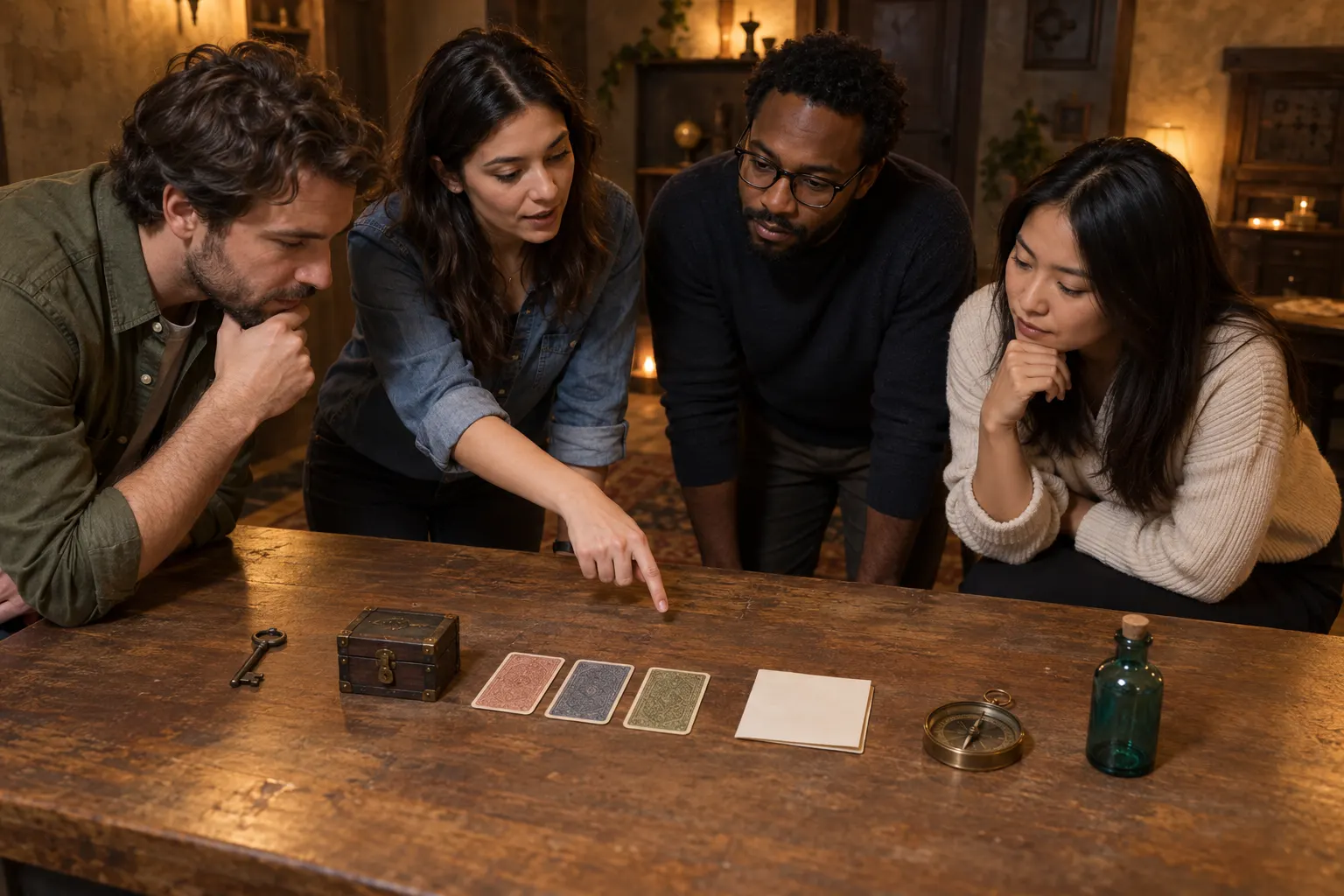
Common escape room puzzles and how to spot them
Rooms reuse a small set of tricks. When you see one of these, you already know where to start.
| If you see | It usually means |
|---|---|
| A lock with four number wheels | Look for four of something: digits, objects, symbols or marks in a row. |
| A lock with letter wheels | It wants a word, and the number of wheels is the length of that word. |
| A lock with arrows (up, down, left, right) | Find a route: a map, a compass, footprints or a list of moves. |
| A UV flashlight in the room | There is invisible ink somewhere: walls, the backs of papers, the floor. |
| A card with holes cut in it | It is a stencil. Lay it over a page of text or a grid of letters. |
| The same symbol on two things | They belong together; one usually tells you how to read the other. |
| A mirror, or writing that looks wrong | Something is written backwards. Hold it up to the mirror. |
| A page of letters that read as nonsense | It is a cipher, and its key is somewhere else in the room. |
| Numbers that never go above 26 | Try letters of the alphabet: 1 is A, 2 is B, 26 is Z. |
| A clock stopped at one time | The hands may be a code: 7:15 can mean 715 or 0715. |
Want to see these puzzles from the other side? Our escape room puzzle ideas show how each type is built, with worked solutions.
When to ask for a hint
A hint is part of the game, not a penalty. Agree on the rule before you go in, then let the clock watcher call it.
- Five minutes, no new idea: ask. Stuck but still trying things is fine. Stuck and repeating the same tries is the moment to call.
- Ask about one puzzle. "We think the map goes with the arrow lock, is that right?" gets a better hint than "help".
- Tell them when a sure code fails. Locks stick and dials slip. The game master can check it in seconds.
- Spend hints on the hour, not the score. Finishing with two hints beats running out of time on puzzle four. Nobody remembers the hint count.
Tips for a virtual escape room
Online rooms on a video call run on the same habits, plus a few of their own.
- Join from a laptop. Clues are small; a phone screen hides the detail you need.
- Keep pen and paper by the keyboard. Some hosted rooms ask for it, and it is faster than a notes app.
- Cameras on in breakout rooms. Pointing at your screen and pulling a face both count as communication.
- Paste every code into the chat. The whole team can check it before anyone types it in.
- Pick one voice for the host. One person asks for hints and answers, so the host isn't hearing six versions.
Our hosted virtual escape rooms run live for an hour on Zoom by default (Teams, Google Meet or Webex on request), with a live host leading small teams through the puzzles. Book about 2 weeks ahead. See every option on our virtual escape rooms page.
Four hosted rooms, with today’s price.
Planning for a big group? Send your date and headcount and get a free quote. We reply within 24 hours.
How to debrief after the room
Ten minutes over a drink or on the walk out is enough. These questions are about how you worked, not who was smartest.
- Which find did we hold onto too long before sharing it?
- When did we split up, and when should we have regrouped?
- Who spotted something nobody else saw?
- Where did two of us work the same lock without knowing?
- What would we do differently in the first five minutes next time?
- Which hint saved us, and could we have asked for it sooner?