DIY escape room: how to design one, plus a ready-to-run office game
Seven steps from story to reset, a budget shopping list and a game master script. Then a printable 45-minute room you can run this week.

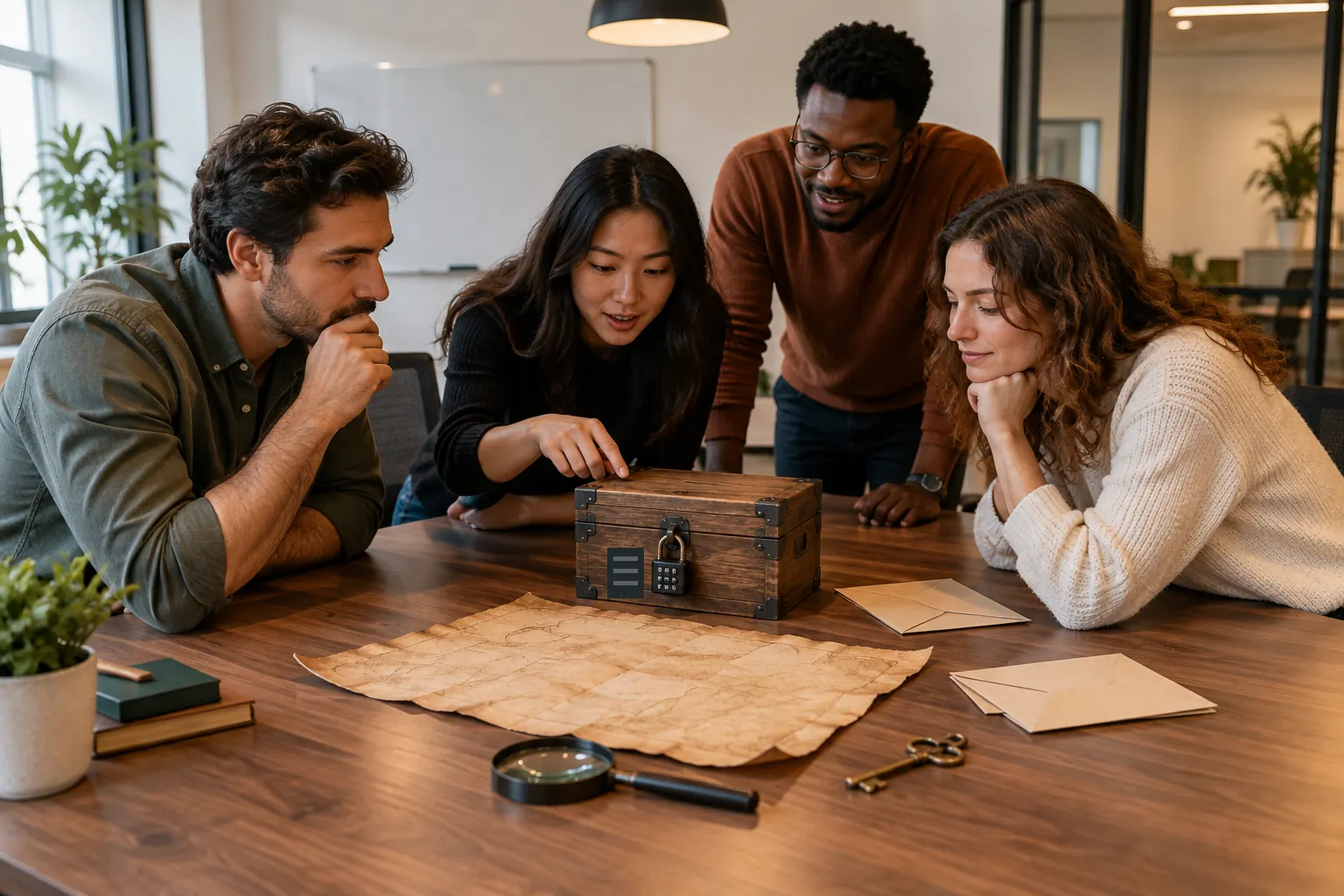
A DIY escape room is a locked box, a story and a chain of puzzles you write yourself, run in a meeting room or a living room. This guide shows how to design an escape room game at home or at work in seven steps: the story, the puzzle flow, the locks and props, the clues, the setup, the game master’s script and the reset. Then comes Moving Day, a ready-to-run office escape room with six printable cards, a lockbox and every answer.
Step 1: Pick a story and a goal
Every good room starts with one sentence and one locked box. Write both before any puzzle.
Fill in the blanks:
You are [who]. [Something] went wrong. Open [the box] before [the deadline], or [what happens].
- You are the event team. The keynote speaker's slides are locked in a case, and the doors open in 45 minutes.
- You are the last shift in the lab. The sample fridge locked itself, and the courier leaves at 5.
- You are the new crew on a research ship. The captain left the radio code in her cabin safe before the storm hit.
What goes in the final box
The box is the goal, so put something in it worth the 45 minutes. Six ideas that work at the office:
- Something to share. Snacks, a cake voucher or the first slice of the team lunch.
- A trophy that travels. A cheap trophy the winners keep on their desks until the next game.
- The story's object. The key, the file or the sample the story promised, made from paper or a toy.
- Certificates. One per player, printed with the team's finish time.
- The next clue. For a two-part event, the box holds the first card of round two.
- A small perk. First pick of the conference room or a long lunch, if a manager signs off.
Stuck for a setting? Our escape room themes list has 35 stories, each with a story hook and a puzzle to match.
Step 2: Plan the puzzle flow
The flow is the order puzzles open in. Pick the shape for your team size, then draw it as boxes and arrows.
- 123Lock
Line
Best for 2 to 4 players, a first room
Every answer opens the next puzzle. It is the easiest flow to build, hint and reset, but only one puzzle is open at a time, so bigger groups end up watching.
- 123Lock
Fan out
Best for 5 to 8 players
Three or four puzzles open at once, and each gives one piece of the final code. Everyone has something to hold, but a team can split up and never talk, so give the last lock a reason to bring them back together.
- 12345Lock
Mixed
Best for 4 to 6 players, most office rooms
Start with one puzzle the whole team solves, fan out in the middle, then merge for the last two locks. The room on this page uses this shape.
Five rules for a flow that works
- Draw it before you write it. One box per puzzle, an arrow for each answer. If a box has no arrow in, nothing leads to it. If it has no arrow out, nothing uses its answer.
- Give every answer one job. An answer opens one lock or points to one place. An answer that does two things is the one teams forget.
- Count the hands. Open puzzles at any moment should be about the team size divided by two. Six players, three puzzles in the fan.
- Save the hardest puzzle for late in the game. Teams are warmed up by then and working together. A hard puzzle first stalls the room before anyone has had a win.
- Budget the minutes. Plan on about 7 or 8 minutes a puzzle for first-time teams, less when puzzles run side by side. Six puzzles fit a 45-minute game with a story and a debrief only if some of them run at the same time.
Need puzzles to fill the boxes? Our escape room puzzle ideas cover 34 DIY escape room puzzles, from ciphers to logic cards, each with a worked example and its solution.
Step 3: Choose locks and DIY escape room props on a budget
One lockbox and one combination padlock make a real escape room. Everything else is optional, and a lot of it is already in the office.
Locks
- Need4-digit combination padlock. The final lock. Get one you can reset to any code, because you will reset it after every team.
- Nice3-digit luggage lock. Small enough to thread through the two pulls of a zip pouch. A pouch plus this lock is the cheapest locked container there is.
- NiceWord lock. Takes a 4- or 5-letter word, so word puzzles can end in a real click instead of a spoken answer.
- NiceKey padlock. The key becomes a prop to hide. Tape it inside a book jacket or under a mug.
Containers
- NeedLockbox or cash box with a hasp. The goal everyone can see from minute one. Of everything on this list, this is the one worth paying a little more for.
- NiceZip pouch or pencil case. Pairs with the luggage lock. Holds cards, scissors and tape for the next stage.
- NiceSmall toolbox or tackle box. Most have a hole in the latch that a padlock fits through.
Paper
- NeedPrinter paper or card stock. Card stock survives more teams and folds cleanly.
- NeedEnvelopes. Number them. The host can play any lock by holding an envelope until the right answer.
- NeedPainter's tape. Hangs clues without marking walls or furniture, and marks what is off limits.
- NeedScissors and pencils. One pair of scissors per team, and pencils for grids that need erasing.
Clue tools
- NiceUV pen and a small UV flashlight. Hidden writing, revealed once the flashlight is found.
- NiceMagnifying glass. Lets you print one line in very small type.
- NiceClipboards. Turn any printout into an official-looking file.
Atmosphere
- FreeA countdown on a big screen. Any online timer on the room display keeps the pressure visible.
- FreeA playlist. Low music fills the quiet moments. Pick one long instrumental track.
- NiceBattery candles or a desk lamp. Lowering the lights changes a meeting room more than any prop.
Already in the office
- FreeChairs, doors and whiteboards. Ready-made hiding places every room has.
- FreeSticky notes and markers. For clues on the fly and for teams to keep notes.
- FreeBooks, mugs and binders. Props that look like they belong there, so they hide clues well.
No locks at all? The host can play every lock: hold the next envelope until a team says the right answer. It works, though nothing beats the click of a real padlock at the end.
Step 4: Write clues people can solve
A clue card is a small piece of writing. These five parts and six rules keep it fair.
What goes on a clue card
- A number on the front. “Card 3” tells the team, and you, exactly where they are.
- One line of story. Who wrote the card and why. It keeps the game a story instead of a worksheet.
- The puzzle itself. Big type, plenty of white space, nothing a team has to guess about.
- One plain instruction. What to do, in one sentence. Mystery is for the story, not for the rules.
- The shape of the answer. “One digit”, “a place in this room, 4 letters”. Teams then know when they are done.
Six rules for clues
- Write the answer first. Pick the code, then build the puzzle that produces it. The other way round, the numbers never come out right.
- Make one idea per card. A card that needs a cipher and a count and a search is three cards. Split it.
- Use only what is in the room. No trivia, no phones, no math harder than adding, taking away and doubling. Anyone on the team could crack any card.
- Build in a check. The best clues confirm themselves: a word that makes sense, or a wrong path that goes nowhere, like an elevator below the lobby.
- Write two hints with every card. The first points at where to look, the second at what to do. Write them now, while you still remember the trick.
- Test on someone who was not there. Watch them play without helping. Every place they stall is a line to rewrite.

Step 5: Set up the room
Allow about 20 minutes for setup, plus the time it takes to test every lock.
- Mark what is off limits. A strip of painter's tape on a cabinet means “not part of the game”. Say so in the briefing.
- Put the goal in plain sight. The locked box sits in the middle of the table from the first minute. Teams play harder for something they can see.
- Hide clues at hand height. Under chairs, behind the door, inside a binder. Nothing above head height, nothing behind heavy furniture.
- Write a lock sheet for the host. Every lock, its code and where each card is hidden, on one page that never leaves the host's pocket.
- Print a spare set. Cards tear and grids get scribbled. A second set saves the game when a card goes missing.
- Do a full dry run. Open every lock with its code and walk the room in order, card by card. Most setup mistakes show up here.
Step 6: Run the game
The game master tells the story, keeps time and gives hints. Here is what to say and when.
Game master script
- Before you start
- “Phones in pockets. Nothing in this game needs force, nothing is above head height, and anything with blue tape is not part of the game.”
- The story
- Read the story aloud, point at the locked box and start the timer as you finish the last sentence.
- Hints
- “Ask me for a hint any time. I'll give you a nudge first, then a bigger one.”
- Every 15 minutes
- “30 minutes left.” Then “15 minutes left.” Time calls keep the energy up.
- Last 5 minutes
- If the team is far off, give the second hint for the card they are on without being asked.
- The finish
- Read the closing line of the story, write the time on the board and take a team photo with the open box.
- Debrief
- “Who cracked which card? Where did we lose time?” Two questions, five minutes. This is where the team building happens.
Pick a hint policy and say it out loud
- Ask any time. Free hints whenever a team asks. Best for a first room and for teams that do not know each other well.
- Hints cost time. Each hint adds 2 minutes to the finish time. Works well when several teams compete on the same room.
- Automatic hints. The host steps in after 5 minutes with no progress. Keeps a quiet team moving without anyone having to admit they are stuck.
Step 7: Reset between teams
Running the room for several teams? Reset in this order and nothing goes missing.
- Close every lock and spin the dials off the code.
- Collect every card, count them and put each back in its numbered envelope.
- Swap in fresh copies of anything teams wrote on, cut or folded.
- Re-hide the envelopes in the same places, checking them against the lock sheet.
- Refill the box: the prize, the story object, a fresh closing note.
- Put back the pens, scissors and tape, and pick up scraps of paper from the last team.
- Reset the timer and check the screen still shows it.
- Plan about 10 minutes between teams, or build a second set and alternate.
A printable escape game: Moving Day, a 45-minute office room
Six DIY escape room puzzles, built to the steps above. Print the cards, set two locks and run it in any meeting room.
- Time:
- 45 minutes, plus 20 minutes of setup
- Players:
- 4 to 6 per team
- Puzzles:
- 6: one together, three side by side, then two
- Locks:
- A 3-digit pouch lock and a 4-digit lockbox
The story
Read this aloud, point at the locked box and start a 45-minute timer.
The office moves to a new floor tomorrow morning. Dana from facilities packed the only key to the new office in this lockbox, set the code and then left for a two-week vacation without telling anyone. Her phone is off. The movers arrive at 8 am, and without that key nobody gets in. Dana did leave a trail of notes, because Dana always leaves notes. You have 45 minutes to open the box.
How the puzzles connect
What you need
- A lockbox or cash box with a 4-digit combination padlock
- A zip pouch with a 3-digit luggage lock through the pulls (or the host holds an envelope instead)
- Three envelopes, numbered 2, 3 and 4
- The six printed cards (use the print button)
- A pencil, a pair of scissors and a few strips of tape
- Painter's tape for hanging cards
- A prize for the box: a key with a NEW OFFICE tag, snacks, or both
Setup, about 20 minutes
- Lock the box. Set the padlock to the card 6 code from the answer key, put the key, snacks and Dana's closing note inside, and leave it on the table.
- Lock the pouch. Set the luggage lock to the code from cards 2, 3 and 4. Put card 5, the scissors and three strips of tape inside.
- Tape envelopes 2, 3 and 4 under three chairs. Use chairs on different sides of the table, and put the pencil in envelope 3.
- Tape card 6 to the back of the door. Shoulder height, on the inside of the room.
- Keep card 1 in your hand. It goes to the team when the timer starts.
The six cards
Each card shows what the team sees. Where it hides, the hints and the answer sit behind the reveal under each one, so you can keep this page open while you host.
Card 1: Dana's memo
Dana typed this in a hurry. Six words each have one wrong letter. Read the wrong letters in order to find where she left the next three envelopes.
Team, the movers arrive tomcrrow at 8. Before you leave tonight, clear the kithhen fridge, eapty your desk driwers into the boxes, stick a labrled tag on every box and unplug your monitsr. Thanks! Dana
Answer: A place in this room, 6 letters
Setup, hints and answer
Setup: Hand card 1 to the team when you start the timer. Everyone works on it together.
Hint 1: Start with tomcrrow. It should say tomorrow. Which letter is the odd one out?
Hint 2: The first two wrong letters are C and H. Keep going through the memo in order.
Answer: CHAIRS. tomcrrow has a C where tomorrow has an O, then kithhen (H), eapty (A), driwers (I), labrled (R) and monitsr (S). The letters spell CHAIRS, and envelopes 2, 3 and 4 are taped under three chairs.
Card 2: The freight elevator log
The elevator starts in the lobby, which is floor 1. On which floor did it finish its last trip? That floor is the FIRST digit of the pouch code.
- 8:05 Up 5 floors, with the desks.
- 8:20 Down 2 floors, with the chairs.
- 8:40 Up to twice the floor it was on, with the plants.
- 9:10 Down 4 floors, with the printer. CANCELLED: the movers took the stairs.
- 9:30 Down 7 floors, with the boxes.
- 9:50 Up 8 floors, with the whiteboard.
Answer: One digit
Setup, hints and answer
Setup: In envelope 2, taped under a chair. Cards 2, 3 and 4 can be solved in any order, at the same time.
Hint 1: Follow the trips one line at a time and write down the floor after each one. Read every line to the end.
Hint 2: One trip never happened. Skip the cancelled 9:10 trip: 1, 6, 4, 8, then down 7 and up 8.
Answer: 9. Floor 1, up 5 to 6, down 2 to 4, double to 8, skip the cancelled trip, down 7 to 1, up 8 to 9. Counting the cancelled trip sends the elevator below the lobby, which is the clue that it never ran.
Card 3: Dana's desk plan
Shade squares in the grid. The numbers beside each row and above each column are the runs of shaded squares in that line, in order, with at least one blank square between runs. The finished picture is the SECOND digit of the pouch code.
2 11 11 7 1 1 2 11 11 5 1 1 Answer: One digit
Setup, hints and answer
Setup: In envelope 3, taped under another chair. Put a pencil in the envelope.
Hint 1: Start with the column whose clue is 7. It is as tall as the grid, so shade every square in it.
Hint 2: The row with clue 5 is completely shaded. After that, the far-right column has only that one square shaded.
Answer: 4. The fourth column is shaded top to bottom and the fifth row runs all the way across, with a diagonal running up from the left. The picture is a 4, and the shading is the only one that fits every clue.
Card 4: The box label
How many times does the letter F appear on this label? Count once, then count again. That number is the THIRD digit of the pouch code.
Moving label
FINAL FILES OF THE YEAR GO OUT FIRST, AHEAD OF THE REST OF THE BOXES
Answer: One digit
Setup, hints and answer
Setup: In envelope 4, taped under a third chair.
Hint 1: Got 3? Count again, and this time look at the short words.
Hint 2: OF counts. It appears three times.
Answer: 6. FINAL, FILES, OF, FIRST, OF and OF: six Fs. The eye skips the small word OF, which is why a quick first count often comes out at 3.
Card 5: The new seating chart
The movers unpack desks in the order on their list. Find each person's desk on the seating chart, then find that desk's tag on the floor plan. Columns are A to D, rows are 1 to 4: desk B1 is column B, row 1.
Seating chart Ana A2 Ben C4 Chloe B1 Dev D3 Emma C3 Femi B4 Gus D1 Hana A3 New floor plan A B C D 1 K D M W 2 O P L E 3 N T R F 4 G O H S Movers’ list: Chloe, Ana, Femi, Emma
Answer: A place in this room, 4 letters
Setup, hints and answer
Setup: Inside the pouch with the 3-digit lock, with scissors and a few strips of tape for card 6. Teams open the pouch with the digits from cards 2, 3 and 4, in that order.
Hint 1: Chloe is first. Her desk is B1: column B, top row. What tag is there?
Hint 2: Chloe, Ana, Femi and Emma give D, O, O and the tag at C3.
Answer: DOOR. Chloe sits at B1 (D), Ana at A2 (O), Femi at B4 (O) and Emma at C3 (R). The tags spell DOOR, and card 6 is taped to the back of the door.
Card 6: Fold the box
Cut out the box and fold it, or picture it folded. Four faces carry a small letter. For A, B, C and D in turn, find the face that sits opposite it on the finished box. Those four digits, in that order, open the lockbox.
3A81C5D2B7Answer: Four digits
Setup, hints and answer
Setup: Taped to the back of the room's door. The lockbox has sat on the table, locked, since the start.
Hint 1: Folding beats guessing. Cut along the outline, crease every inside line and tape it into a box.
Hint 2: On this shape, opposite faces are not every other square. Face A ends up across from the face with a 5.
Answer: 5873. Folded, the staircase net puts 3 across from 5, 8 across from 2 and 1 across from 7. So A (3) faces 5, B (2) faces 8, C (1) faces 7 and D (5) faces 3: the code is 5873. Teams who count every other square, as if the net were a straight strip, get a wrong code and the lock stays shut.
Host run sheet
- 0:00 · 3 min
Read the story. Point at the locked box, read Dana's story aloud, give the rules (nothing above head height, nothing forced, ask for hints any time) and start a 45-minute timer.
- 0:03 · 6 min
Card 1, together. Hand over Dana's memo. When a team names the right spot, let them search. Finding three envelopes at once sets them loose.
- 0:09 · 14 min
Cards 2, 3 and 4, side by side. Teams usually split up here. Walk between the groups and offer a hint to anyone stuck for 3 minutes. Remind them which digit each card gives.
- 0:23 · 8 min
Card 5, the seating chart. The pouch opens on the code from cards 2, 3 and 4. Once a team reads the four desk tags, they usually all head for the hiding spot at once.
- 0:31 · 10 min
Card 6, the box. Let them cut and fold. Give the second hint at the 40-minute mark if the lockbox is still shut.
- 0:41 · 4 min
Open the box and debrief. Read Dana's last note, hand out the snacks, then ask two questions: who cracked which card, and where did the team lose time?
When the box opens, read: The padlock clicks open on the last digit. Inside is a brass key on a tag that reads NEW OFFICE, a bag of snacks and one more note from Dana: “Knew you'd manage. Save me a desk by the window.”
Remote team? Send each card as an image to a team captain in your chat app when the last answer comes in, and play both locks yourself. Swap the chairs and the door for “ask the host for envelopes 2 to 4” and “ask the host for card 6”. Folding works at home too: everyone prints card 6.
Want more rooms in the same style? Our Halloween escape room and Christmas escape room are printable too, and our free online escape room plays in the browser with nothing to set up.
Rather have someone run the escape room?
Our virtual escape rooms are hosted live: the host sets the scene on the main call, then sends small teams into breakout rooms to solve linked puzzles, with scoring. They run about an hour on Zoom by default (Teams, Google Meet or Webex on request), with no props to buy and nothing to reset. Book about 2 weeks ahead.
Two hosted escape rooms, with today’s prices.
Planning a bigger team event? Get a free quote.
