15 Día de los Muertos activities for work, and what the day means
A living tradition of remembering loved ones, not a party theme. Here is what it means and how a workplace can honor it with care.

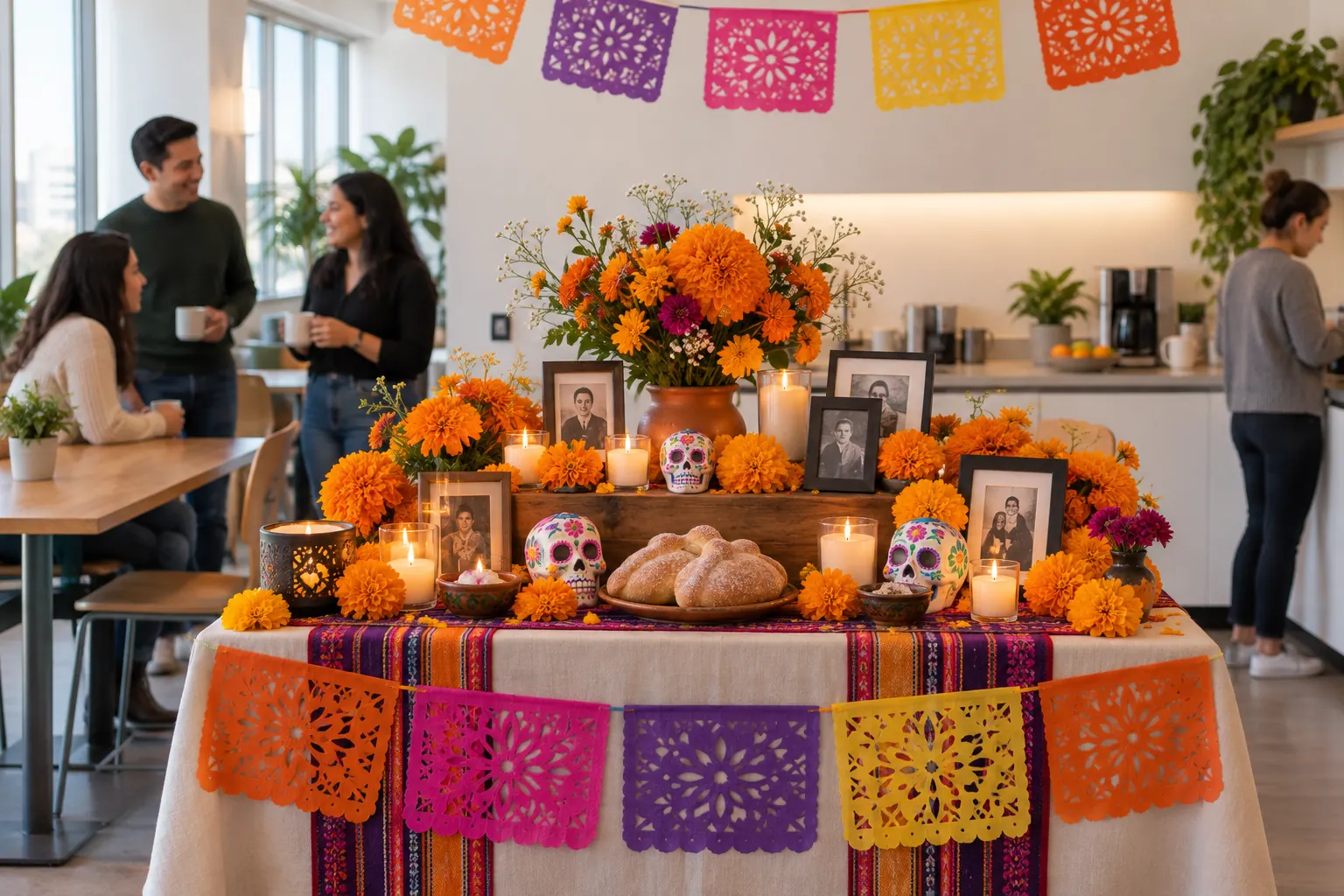
The best Día de los Muertos activities for work are quiet, optional and led by the people who celebrate. Día de los Muertos, the Day of the Dead, is a Mexican tradition held on November 1 and 2, when families welcome back the memory of loved ones who have died with an ofrenda, marigolds, candles and their favorite foods. Below you’ll find what the day means, the traditions behind it, how to celebrate it at work, 15 respectful activities, a 45-minute plan with an invite you can copy, and what to leave out.
What is Día de los Muertos?
A two-day observance, every year on November 1 and 2, when families remember and celebrate the people they have lost. The belief is that the souls of the dead return to visit, so the living prepare a welcome. In many places November 1 is for children who have died and November 2 for adults. It is celebrated across Mexico, in parts of Central America and by Mexican American communities across the US.
It grew from Indigenous traditions of honoring ancestors that later joined with All Saints’ Day and All Souls’ Day, which fall on the same dates. UNESCO lists Mexico’s Indigenous festivity dedicated to the dead as Intangible Cultural Heritage of Humanity. The mood is warm and often joyful, with music, food and stories. It is not “Mexican Halloween”:
| Aspect | Día de los Muertos | Halloween |
|---|---|---|
| When | November 1 and 2 | October 31 |
| Roots | Indigenous Mexican traditions of honoring ancestors, joined with All Saints' and All Souls' Days | The Celtic festival of Samhain and the eve of All Saints' Day |
| Purpose | Welcoming and remembering loved ones who have died | Costumes, candy and playful scares |
| Mood | Warm, joyful and reflective | Spooky and silly |
| Symbols | Ofrendas, marigolds, candles, pan de muerto, sugar skulls | Jack-o'-lanterns, costumes, ghosts and witches |
In 2026, November 1 falls on a Sunday and November 2 on a Monday, so Monday, November 2 is the natural day for an office gathering.
The ofrenda and other Day of the Dead traditions
Most of what you see around these days comes back to the ofrenda. Knowing what each piece means is the first step to honoring it well.
- Ofrenda (offering)
- The altar a family builds at home, often in tiers, to welcome the souls of loved ones back for the visit. Everything below can go on it.
- Cempasúchil (Mexican marigold)
- Bright orange flowers whose color and scent are said to guide the souls home. Some families scatter the petals in a path to the altar.
- Velas (candles)
- Candles light the way. Many families light one for each person they remember.
- Fotos (photos)
- Pictures of the people being remembered, placed by those who knew them. Photos of living people stay off the ofrenda.
- Pan de muerto (bread of the dead)
- A soft, sweet bread, often scented with orange blossom or anise, topped with dough bones and sugar.
- Calaveras de azúcar (sugar skulls)
- Molded sugar skulls decorated with bright icing, often with a name across the forehead. They are cheerful, not scary.
- Papel picado (cut paper)
- Tissue paper cut into lacy patterns and strung as banners that flutter above the altar.
- Agua y sal (water and salt)
- A glass of water for the souls' thirst after a long journey, and in many homes a little salt for purification.
- Copal (resin incense)
- Tree resin burned as incense, a practice with Indigenous roots, to purify the space and help guide the souls.
- Comida favorita (favorite food)
- The dishes, sweets and treats the person loved, from tamales and mole to a favorite candy.
- Objetos personales (personal things)
- A hat, a book, a toy for a child who died: small things that make the person feel present.
- Calaveras literarias (literary skulls)
- Short, funny rhyming verses that imagine Death coming to call, often about public figures. A playful way to look at mortality.
- La Catrina
- The elegantly dressed skeleton lady. The Mexican printmaker José Guadalupe Posada first drew her in the early 1900s to poke fun at people who put on upper-class airs, and the muralist Diego Rivera later gave her the name Catrina. She is a reminder that death comes to everyone, rich or poor.
What do people do on the Day of the Dead?
- Build an ofrenda at home in the last days of October.
- Clean and decorate family graves with marigolds and candles, then spend time there together. In some towns families stay through the night.
- Cook the favorite dishes of the people they remember, and share them.
- Tell stories about loved ones, so younger relatives come to know them.
- Share pan de muerto with family, friends and neighbors.
- Write calaveras literarias and give sugar skulls with friends' names on them.
- Join community processions, concerts and exhibits, in Mexico and in US cities with large Mexican American communities.
How to celebrate Day of the Dead at work, respectfully
Knowing how to celebrate Día de los Muertos at work mostly means making room for the tradition without turning it into an event. Seven rules for whoever is planning:
- Start with the people who celebrate. Ask your Latino or Hispanic employee group, or colleagues who mark the days, whether they'd like the company to observe it and how. Offer a budget and the credit, not the workload.
- Call it what it is. Use the name Día de los Muertos or Day of the Dead, and keep it apart from the Halloween party: a different day, a different room and a different mood.
- Keep every part opt-in. Nobody has to add a photo, speak or attend. Grief is personal, and someone on the team may have lost a person this year.
- Give it a quiet place. Put the ofrenda where people can stop for a minute, away from the coffee line and the noise.
- Explain rather than decorate. Cards that explain each element, a short talk or a reading do more than decorations with no context.
- Buy from Mexican-owned businesses. Bread from a local panadería, flowers from a local florist and crafts from Mexican artisans keep the money with the community the tradition comes from.
- Mind the dates. Put the ofrenda up a few days before November 1, keep it through November 2, then return every photo and object to its owner. If both days fall on a weekend, keep it up the week before.
The same principles run through our guide to inclusive holiday party ideas, and if your team also marks Hispanic Heritage Month, these Hispanic Heritage Month activities pair well with what follows.
15 Día de los Muertos activities for work
Pick two or three, not all of them. Every one works for a team that is new to the tradition, and none needs anyone to dress up.
Remember together
The heart of the day. Small, quiet and always optional.
1. A shared office ofrenda
Set a small table in a quiet corner with a cloth, marigolds, battery candles, pan de muerto and a glass of water. Invite colleagues to add a photo or the written name of someone they miss, and a small treat or object that person loved. Nobody adds anything on someone else's behalf, and every photo goes back to its owner afterward.
Up a few days before November 1, down after November 2 · Office · Side table, cloth, flowers, battery candles
2. Cards that explain each element
Print small folded cards that explain each item in a sentence: why the marigolds, the water, the salt and the bread. Colleagues new to the tradition can learn without having to ask the person who set it up.
20 min to make · Office · Card stock and a printer (use the list of elements above)
3. A remembrance card box
Leave blank cards, pens and a small box beside the ofrenda. People write a name and one memory of someone they miss, signed or not, and add it to the altar. Some people find writing easier than bringing a photo.
All week · Office · Blank cards, pens, a box
4. A virtual ofrenda for remote teams
Open one shared slide or digital whiteboard for November 1 and 2, and invite people to add a photo or a name and one line about the person, if they want to. Show it at the start of a team meeting for a quiet minute. Keep it visible to the team only, and let people remove their own entries at any time.
15 min to set up · Remote or hybrid · A shared slide deck or whiteboard
Share food
Food is how the ofrenda welcomes people, and it is the easiest way to bring everyone in.
5. Pan de muerto and hot chocolate morning
Order pan de muerto from a local Mexican bakery and make a pot of Mexican hot chocolate, which is lightly spiced and whisked until frothy. Put a card by the bread explaining that the dough on top is shaped like bones.
30 min · Office · Order a few days ahead: bakeries are busiest in late October
6. A recipes-we-remember potluck
Invite people to bring a dish someone they've lost used to make, with a card naming the cook and one line about them. Food is at the center of the ofrenda, and this lets everyone take part through their own family story.
Lunch hour · Office · Label every dish with its ingredients
Make something
Day of the Dead projects for a lunch hour. Everything you make can go on the ofrenda.
7. Papel picado workshop
Fold sheets of colored tissue paper and cut small shapes along the folds, then open them up and string the sheets into a banner for the ofrenda. Artisans cut papel picado with chisels through stacks of paper; scissors are the easy way to try it at a desk.
45 min · Office or remote · Tissue paper, scissors, string
8. Paper marigolds
Make cempasúchil from orange and yellow tissue paper: stack eight sheets, fold them like a fan, tie the middle and gently pull each layer apart. They outlast fresh flowers and cost very little.
30 min · Office or remote · Tissue paper, pipe cleaners
9. Sugar skull decorating
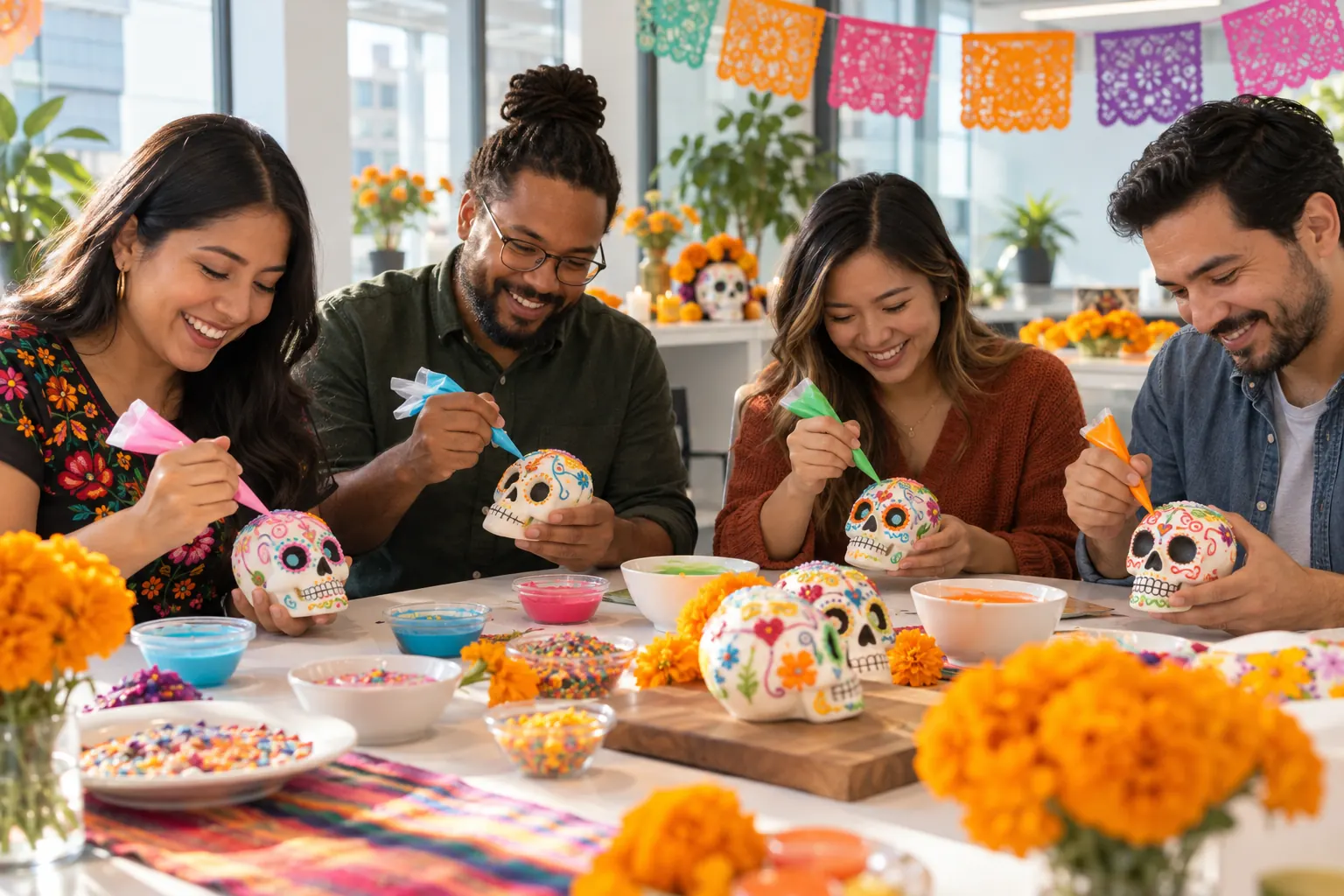
Decorate ready-made sugar skulls or skull-shaped cookies with icing, sprinkles and colored foil. Buy food-safe kits from a Mexican-owned maker if you can. Names often go on the forehead: a loved one's for the ofrenda, or the decorator's own to take home. Keep it a craft, not a costume: no skull face paint for the team.
45 min · Office · Food-safe sugar skulls, icing, sprinkles
10. A card to someone you remember
Give everyone a blank card, good pens and fifteen quiet minutes to write to someone they miss, to keep, to place on the ofrenda or to take home. Some will write to a grandparent, some to a friend, and some will simply decorate. With an instructor and a kit at every home, try our calligraphy and card-making class.
30 min · Office or remote · Blank cards, pens
Learn and listen
For teams who want to understand the tradition, not just see it.
11. A colleague-led talk, only if they offer
If a colleague who celebrates would like to share how their family marks the days, give them a lunch slot, a budget and the credit. Ask privately, accept a no without follow-up, and never make it part of anyone's job.
30 min · Office or video call
12. A lunch-and-learn with an outside speaker
Invite a speaker from a local Mexican cultural center, museum or university to explain the history and regional traditions, and pay them for their time. It takes the teaching off your Mexican and Mexican American colleagues. More ideas for the format: lunch and learn topics.
45 to 60 min · Office or video call · A speaker fee
13. A playlist of Mexican music
Build a shared playlist for the week with mariachi, son jarocho, boleros, ranchera and cumbia. Start with "La Llorona", a traditional song often heard around these days, and ask colleagues to add the songs their families play.
10 min · Office or remote · A shared playlist
14. A Coco lunch screening
Pixar's Coco (2017) is set during Día de los Muertos and shows the ofrenda, the marigold petals and the family photos with care. Screen it over two lunch hours and end with a short talk about what it gets across.
Two lunches · Office · Check that your license covers a screening at work
15. A visit to a community ofrenda
Many museums, libraries and Mexican cultural centers in US cities set up ofrendas and hold community events around November 1 and 2. Go as a small group, follow the hosts' guidance and buy from the artisans and food vendors there.
1 to 2 hours · In person · Free or a small entry fee
A 45-minute Día de los Muertos gathering, ready to run
Works in a break room or a conference room. Swap in any activity from the list above.
- Welcome (5 min). The host explains in two minutes what the day is, says that every part is optional, and thanks whoever helped plan it.
- Visit the ofrenda (10 min). People read the element cards and add a photo, a name or a card if they want to.
- Pan de muerto and hot chocolate (10 min). Bread from a local bakery, a pot of Mexican hot chocolate and a non-dairy option.
- Make something (15 min). Paper marigolds or a small papel picado sheet, added to the ofrenda before people leave.
- Close (5 min). A quiet moment. Anyone who wants to may share a name or a memory, with no pressure, and the host says when the ofrenda comes down and photos go back.
An invite you can copy
Fill in the brackets, and send it from whoever is hosting.
Email invite
Subject: Día de los Muertos at the office, Monday, November 2 On November 1 and 2, many Mexican and Mexican American families remember loved ones who have died with an ofrenda: an altar of photos, marigolds, candles and favorite foods. With the help of [names or group], we're setting up a small ofrenda in [place] from [date] through November 2. You're welcome to add a photo, a name or a note about someone you miss. It's completely optional, and every photo comes back to you afterward. On Monday, November 2 at [time], join us for pan de muerto, hot chocolate and 15 minutes of paper flower making. Come by to learn a little, remember someone, or just enjoy the bread.
What to avoid
Most missteps come from treating the day as decoration. Leave these out:
- Calling it "Mexican Halloween" or folding it into the Halloween party.
- Costume contests or skull face paint as an office theme. Catrina makeup is part of some community celebrations, but as office dress-up it turns a remembrance into a costume.
- Asking a Mexican or Mexican American colleague to explain or represent the tradition. Not everyone of Mexican heritage celebrates it, and many who do keep it private.
- Photos of living people on the ofrenda, or photos added by anyone other than the people who knew the person.
- Using the ofrenda as decor or a photo backdrop. Ask before taking pictures of it.
- Building the day around drinks, or buying mass-produced party decor in place of work by Mexican artisans.
Running a Halloween party the same week? Keep the two apart, and use our Halloween games for work for that one.
Want to keep learning together?
We don’t sell a Día de los Muertos event, and we think the best observance is the one your own people lead. Any time of year, a live host can run an hour of Hispanic heritage trivia and team games on Zoom (Teams, Google Meet or Webex on request), booked about 2 weeks ahead. Kit classes need about 3 weeks to ship, so book one at least 3 weeks before the day you plan to gather.
A hosted trivia hour and a card-making kit class, with today’s prices.
Want questions to run yourself? Try these Hispanic Heritage Month trivia questions. Planning November too? Here are Thanksgiving games for work, or get a free quote for any team event.
